Ammonia → 11-Cyanoundecanoic acid
반응식

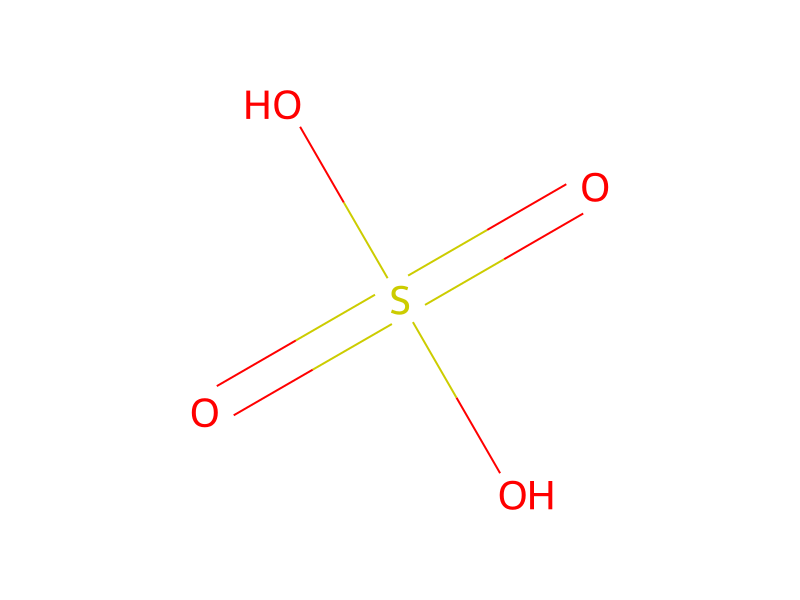
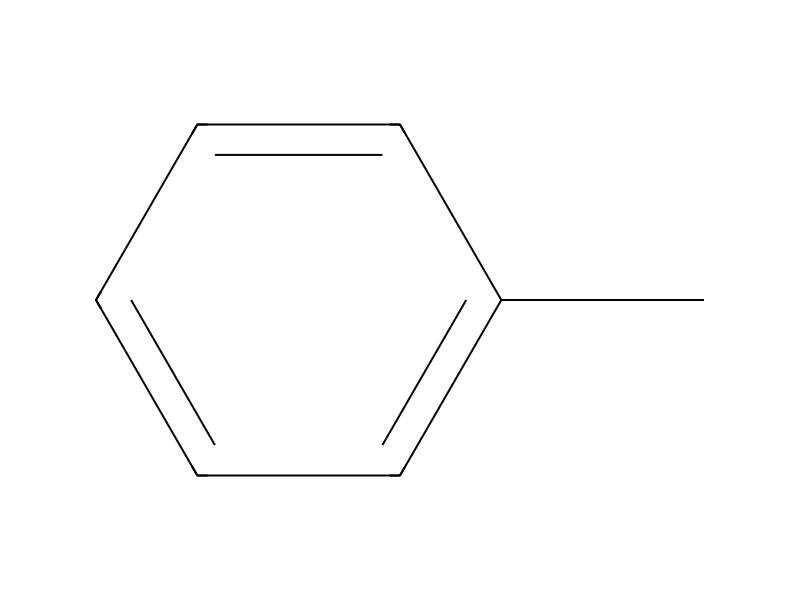
[NH3:1].[C:2]1(=[O:8])[CH2:7][CH2:6][CH2:5][CH2:4][CH2:3]1.S(=O)(=O)(O)[OH:10].[C:14]1(C)[CH:19]=[CH:18][CH:17]=[CH:16][CH:15]=1>>[C:14]([CH2:15][CH2:16][CH2:17][CH2:18][CH2:19][CH2:3][CH2:4][CH2:5][CH2:6][CH2:7][C:2]([OH:8])=[O:10])#[N:1]참가 물질



실험 절차
Gaseous ammonia was blown into the liquid pyrolysis product, and the liquid was separated into the oily layer (I) and the aqueous layer. The aqueous phase was passed through a multi-stage extraction tower provided with thirty perforated plates where the aqueous layer was contacted countercurrently with 12.22 parts of toluene, thereby to extract cyclohexanone from the aqueous layer. Thus, there were obtained the toluene solution (II) containing cyclohexanone and the aqueous raffinate. 4.58 Parts of a 20% aqueous sulfuric acid were added to the aqueous extraction residue to adjust the pH thereof to 3.0, keeping the aqueous raffinate at a temperature of 60° C., and the resultant product was separated into two layers, i.e., a crude molten free 11-cyanoundecanoic acid layer and the aqueous layer (III) containing a substantial part of ε-caprolactam. The crude molten 11-cyanoundecanoic acid layer still contained small amounts of ε-caprolactam and other by-products. The crude molten 11-cyanoundecanoic acid layer was passed through a twenty stage rotary disk extraction tower where the crude molten 11-cyanoundecanoic acid was contacted countercurrently with 40.13 parts of hot water to extract ε-caprolactam, whereby there were obtained 2.64 parts of molten 11-cyanoundecanoic acid and the collected washing water (IV). The molten 11-cyanoundecanoic acid was cooled to be solidified, pulverized and, then, dried to obtain a crystalline product containing 2.24 parts of 11-cyanoundecanoic acid. A one percent solution of the crystals exhibited a Hazen number of 48.
후처리
- customthe liquid was separated into the oily layer (I)
- extractionThe aqueous phase was passed through a multi-stage extraction tower
- customprovided with thirty perforated plates where the aqueous layer
- extractionto extract cyclohexanone from the aqueous layer
- customThus, there were obtained the toluene solution (II)
- customat a temperature of 60° C.
- customthe resultant product was separated into two layers, i.e.
- additionthe aqueous layer (III) containing a substantial part of ε-caprolactam
- extractionThe crude molten 11-cyanoundecanoic acid layer was passed through a twenty stage rotary disk extraction tower where the crude
- extractionto extract ε-caprolactam
출처 및 근거
- ORD 기록
- ord-62c5913e5ffb4bb6a15167e8d3c94f94
- 출처 데이터셋
- uspto-grants-1979_08
- 특허 번호
- US04165328
반응 노트
불러오는 중…