Fluorobenzene → 1-(1,1-Dimethylethyl)-4-fluorobenzene
Reaction equation

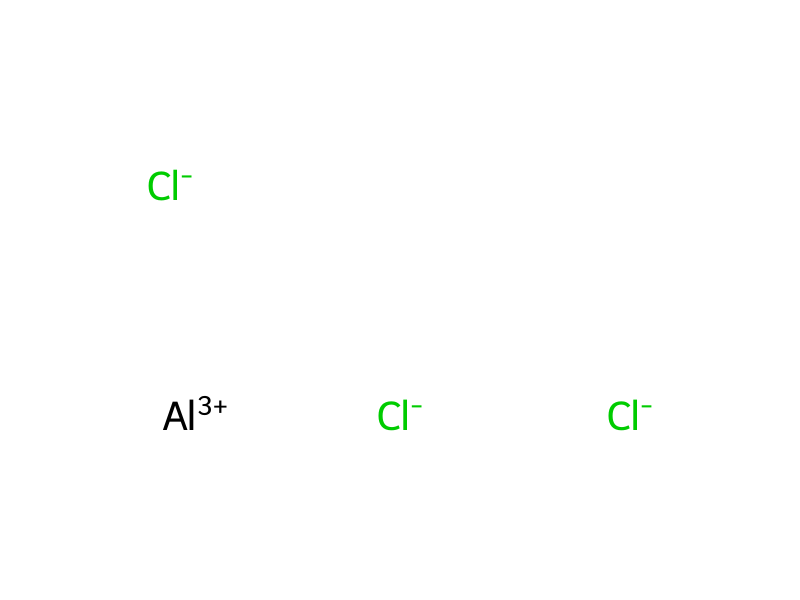
[C:1]([C:5]1[CH:6]=[CH:7][C:8]([F:12])=[C:9](O)[CH:10]=1)([CH3:4])([CH3:3])[CH3:2].FC1C=CC=CC=1.C(Cl)(C)(C)C>[Cl-].[Al+3].[Cl-].[Cl-].[N+](C)([O-])=O>[C:1]([C:5]1[CH:6]=[CH:7][C:8]([F:12])=[CH:9][CH:10]=1)([CH3:4])([CH3:2])[CH3:3]Participants


Procedure
In this example 5-t-butyl-2-fluorophenol, the starting material for the dealkylation process of this invention, was prepared by first alkylating 480 grams of fluorobenzene with 370 grams of t-butylchloride in the presence of 16.6 grams of aluminum chloride and 33 grams of nitromethane as solvent for the reaction at a temperature ranging from about 0° to 2° C., the t-butylchloride being added incrementally to the mixture of fluorobenzene, aluminum chloride and nitromethane in about 2.5 hours and maintained for about an additional hour at this temperature. The resulting 4-t-butyl-fluorobenzene was recovered by treating the reaction mixture with 150 ml water at 0°-10° C. followed by washing with 5% aqueous NaOH, and the organic layer was then separated, followed by fractionation at about 5 mm reduced pressure and 547 grams of product collected from about 48°-52° C. to yield about a 70% conversion and 86% selectivity to p-t-butylfluorobenzene via gas liquid chromatographic analysis. Following this 304 grams of 4-t-butylfluorobenzene so prepared and a catalyst comprising 12.3 grams of iodine were placed in another reaction apparatus and brominated by incrementally adding about 372 grams of bromine during a period of about 3 hours while maintaining the temperature of the reaction at about 60°-65° C., and then maintaining the reaction mixture for about an additional 9 hours. Upon completion of the bromination the organic layer was washed with saturated sodium thiosulfate solution and then with water, dried and the recovered 312 grams of product was fractionated under a reduced pressure of about 3 mm to isolate about 224 grams of the desired 4-t-butyl-2-bromofluorobenzene distilling at about 40°-77° C. The heart cut of this distillate of about 171 grams analyzed about 90% pure via gas liquid chromatography. To obtain the next product comprising 5-t-butyl-2-fluorophenol the thus formed 4-t-butyl-2-bromo-fluorobenzene (20.0 grams) was hydrolyzed by treatment with 160 ml of water in the presence of 18.6 grams of potassium fluoride and 1.0 grams of cuprous oxide plus 40 grams of sulfolane as a co-solvent, said reaction being effected at an elevated temperature of 250° C. and under a nitrogen atmosphere at a total pressure of about 525 pounds per square inch. At the end of about eight hours of reaction period, the autoclave and contents thereof were allowed to return to room temperature, the excess pressure was discharged, and the product recovered from the mixture by extraction with toluene. Distillation under reduced pressure provided about 11.4 grams of the desired product comprising 5-t-butyl-2-fluorophenol corresponding to a conversion of about 85% and a selectivity of about 70%. N-methylpyrrolidone may also be effectively used as the co-solvent in this hydrolysis.
Workup
- customranging from about 0° to 2° C.
- temperaturemaintained for about an additional hour at this temperature
- customThe resulting 4-t-butyl-fluorobenzene was recovered
- additionby treating the reaction mixture with 150 ml water at 0°-10° C.
- washby washing with 5% aqueous NaOH
- customthe organic layer was then separated
- customcollected from about 48°-52° C.
Sources & evidence
- ORD record
- ord-f743c090be194890bf94298ef134017c
- Source dataset
- uspto-grants-1979_05
- Patent number
- US04152529
Reaction notes
Loading…