Acetone → HCID 21319892, compound
Reaction equation

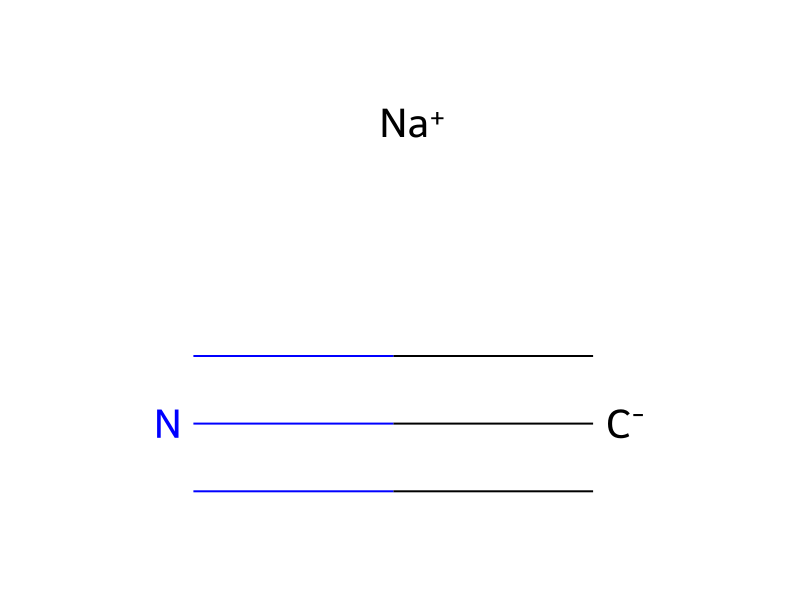
Br[CH2:2][C:3]1[CH:4]=[CH:5][C:6]2[O:10][C:9]([N+:11]([O-:13])=[O:12])=[C:8]([C:14]3[CH:19]=[CH:18][CH:17]=[CH:16][CH:15]=3)[C:7]=2[CH:20]=1.CC(C)=O.C(O)C.[C-:28]#[N:29].[Na+]>O>[C:28]([CH2:2][C:3]1[CH:4]=[CH:5][C:6]2[O:10][C:9]([N+:11]([O-:13])=[O:12])=[C:8]([C:14]3[CH:19]=[CH:18][CH:17]=[CH:16][CH:15]=3)[C:7]=2[CH:20]=1)#[N:29]Participants
Reactant 4



Product 1

Reagents, catalysts & solvents 1

Procedure
A solution of 5-bromomethyl-2-nitro-3-phenylbenzofuran (5 g., 0.015 mole) in 95 ml. of acetone is treated with 20 ml. of ethanol, and the mixture is heated to its reflux temperature. To this mixture is added 0.015 mole of sodium cyanide dissolved in 9 ml. of water, and refluxing is continued for about two hours. The mixture is evaporated under vacuum, then dichloromethane and water are added to the residue. The organic layer is separated, washed with water and dried. The organic layer is then evaporated under vacuum. The residue is purified by eluting twice with benzene through a silica gel column, followed by refluxing in 30 ml. of diethyl ether. The yellow precipitate is separated by filtration and recrystallized twice from benzene to provide 5-cyanomethyl-2-nitro-3-phenylbenzofuran, m.p. 166°-168° C.
Workup
- temperaturereflux temperature
- dissolutiondissolved in 9 ml
- customThe mixture is evaporated under vacuum
- additiondichloromethane and water are added to the residue
- customThe organic layer is separated
- washwashed with water
- customdried
- customThe organic layer is then evaporated under vacuum
- customThe residue is purified
- washby eluting twice with benzene through a silica gel column
- temperatureby refluxing in 30 ml
- customThe yellow precipitate is separated by filtration
- customrecrystallized twice from benzene
Sources & evidence
- ORD record
- ord-fb4c54cfdf244d80b77c4e87a8dfc74c
- Source dataset
- uspto-grants-1979_05
- Patent number
- US04153619
Reaction notes
Loading…