Acetic Anhydride → 2-Chloro-6-cyano-4-(3-fluorosulfonylphenylazo)phenyl acetate
Reaction equation
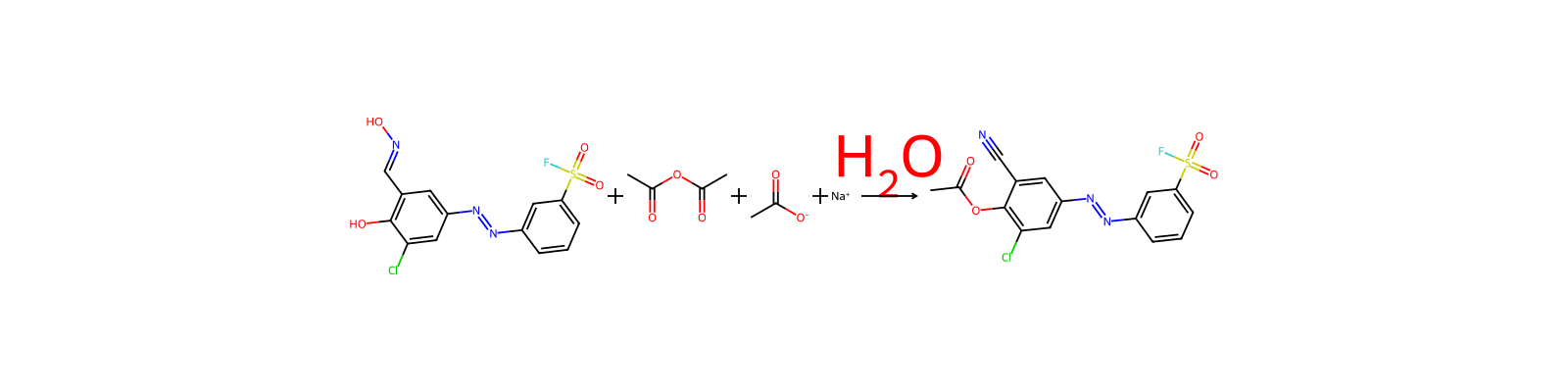
[Cl:1][C:2]1[C:3]([OH:23])=[C:4]([CH:8]=[C:9]([N:11]=[N:12][C:13]2[CH:18]=[CH:17][CH:16]=[C:15]([S:19]([F:22])(=[O:21])=[O:20])[CH:14]=2)[CH:10]=1)[CH:5]=[N:6]O.[C:24](OC(=O)C)(=[O:26])[CH3:25].C([O-])(=O)C.[Na+]>O>[C:24]([O:23][C:3]1[C:4]([C:5]#[N:6])=[CH:8][C:9]([N:11]=[N:12][C:13]2[CH:18]=[CH:17][CH:16]=[C:15]([S:19]([F:22])(=[O:21])=[O:20])[CH:14]=2)=[CH:10][C:2]=1[Cl:1])(=[O:26])[CH3:25]Participants
5




Conditions
- Temperature
- 95 °C
Procedure
3-Chloro-5-(3-fluorosulfonylphenylazo)-2-hydroxybenzaldehyde oxime (22.5 g, 0.063 mol) was added to 150 ml acetic anhydride and heated to 95° C. Sodium acetate (3.0 g) was added. After 21/2 hours, the reaction mixture was poured into 750 ml water and stirred at room temperature until anhydride fully hydrolysed. The resulting precipitate was filtered off. The solids which became gummy on standing were dissolved in 75 ml chloroform and poured onto a silica gel column. Elution with 10% hexane in chloroform gave the desired dye as the first component. Removal of the solvents under reduced pressure gave an oil which hardened on standing but did not crystallize. Yield: 16.8 g (70%).
Workup
- filtrationThe resulting precipitate was filtered off
- dissolutionon standing were dissolved in 75 ml chloroform
- additionpoured onto a silica gel column
- washElution with 10% hexane in chloroform
- customgave the desired dye as the first component
- customRemoval of the solvents under reduced pressure
- customgave an oil which
- customdid not crystallize
Sources & evidence
- ORD record
- ord-078c782d6ac345aca44b934ef6417c84
- Source dataset
- uspto-grants-1979_05
- Patent number
- US04156609
Reaction notes
Loading…