HuagongsheHuagongshe Chemistry Print Report · For research reference only
Hydrochloric Acid → 3-Chloro-5-(3-fluorosulfonylphenylazo)-2-hydroxybenzaldehyde oxime
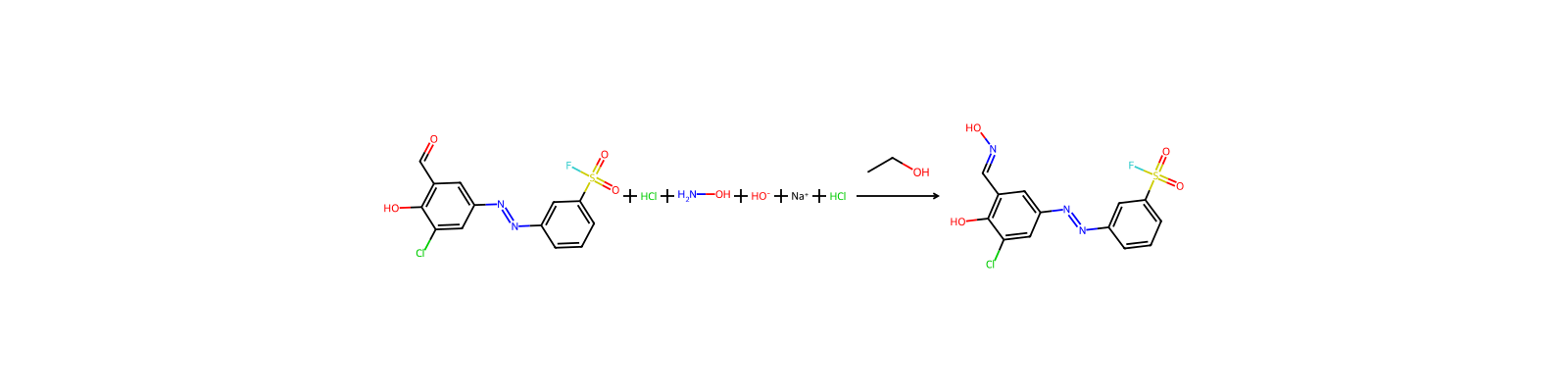
Participants
| Role | Name | HCID | Charge |
|---|---|---|---|
| Reactant | Hydrochloric Acid | HCID 313 | — |
| Reactant | Sodium Hydroxide | HCID 14798 | — |
| Reactant | Hydroxyamine hydrochloride | HCID 443297 | — |
| Reactant | 3-Chloro-5-(3-fluorosulfonylphenylazo)-2-hydroxy benzaldehyde | HCID 135677442 | — |
| Solvent | Ethanol | HCID 702 | — |
| Product | 3-Chloro-5-(3-fluorosulfonylphenylazo)-2-hydroxybenzaldehyde oxime | HCID 136398799 | — |
Reaction Steps
3-Chloro-5-(3-fluorosulfonylphenylazo)-2-hydroxy-benzaldehyde (23.8 g, 0.07 mol) was added to 250 ml ethanol, followed by hyroxylamine hydrochloride (5.04 g, 0.072 mol) and sodium hydroxide (2.88 g, 0.072 mol). The reaction was brought to reflux for 30 minutes and then cooled to room temperature. The mixture was then poured into ice and hydrochloric acid, resulting in the formation of a precipitate which was filtered off, washed with water, and dried in a vacuum oven (55° C.). The yield was 22.5 g (90%).
Provenance & Evidence
| DOI | 10.6084/m9.figshare.5104873.v1 |
|---|---|
| Patent number | US04156609 |
| Source dataset | uspto-grants-1979_05 |
| ORD ID | ord-01923fdcfdd64eb28c5da51d4afcecf2 |
| Source note | uspto-grants-1979_05 |