Hydroxyacetone → 1-Propanol, 2-[(2,3,4-trifluorophenyl)amino]-
Reaction equation

[F:1][C:2]1[C:8]([F:9])=[C:7]([F:10])[CH:6]=[CH:5][C:3]=1[NH2:4].[OH:11][CH2:12][C:13](=O)[CH3:14]>>[OH:11][CH2:12][CH:13]([NH:4][C:3]1[CH:5]=[CH:6][C:7]([F:10])=[C:8]([F:9])[C:2]=1[F:1])[CH3:14]Participants

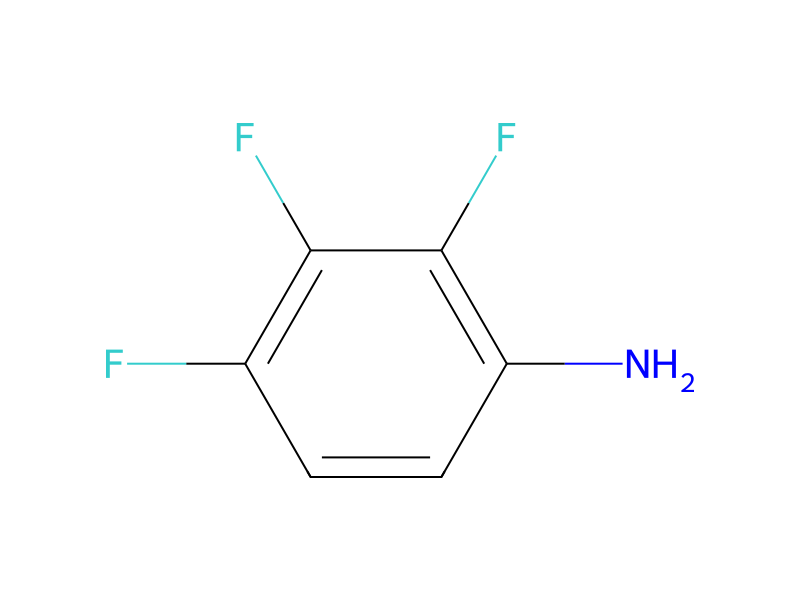

Procedure
2,3,4-trifluoroaniline was reductively alkylated in the presence hydroxyacetone using a Raney Nickel catalyst. Raney nickel (14 ml of 50% aqueous Raney nickel catalyst was slurried in 100 ml of absolute methanol. The mixture was allowed to settle and 90-95% of the liquid was decanted. The process was then repeated three times. 2,3,4-Trifluoroaniline (7.3 g, 0.05 mole) was charged into a glass autoclave liner containing the catalyst. Hydroxyacetone (3.7 g, 0.05 mole) was then added and the mixture was purged with nitrogen. Hydrogenation was initiated at 65° C. and continued to a maximum temperature of 85° C. Hydrogen uptake continued for 0.5 hour between 430 and 450 psi at which time 75% of the alkylated product (3) was obtained with the remainder being unreacted 2,3,4-trifluoroaniline and hydroxyacetone.
Sources & evidence
- ORD record
- ord-65f2f53c8e7c43ce9c986eb9893fab05
- Source dataset
- uspto-grants-1997_07
- Patent number
- US05644056
Reaction notes
Loading…