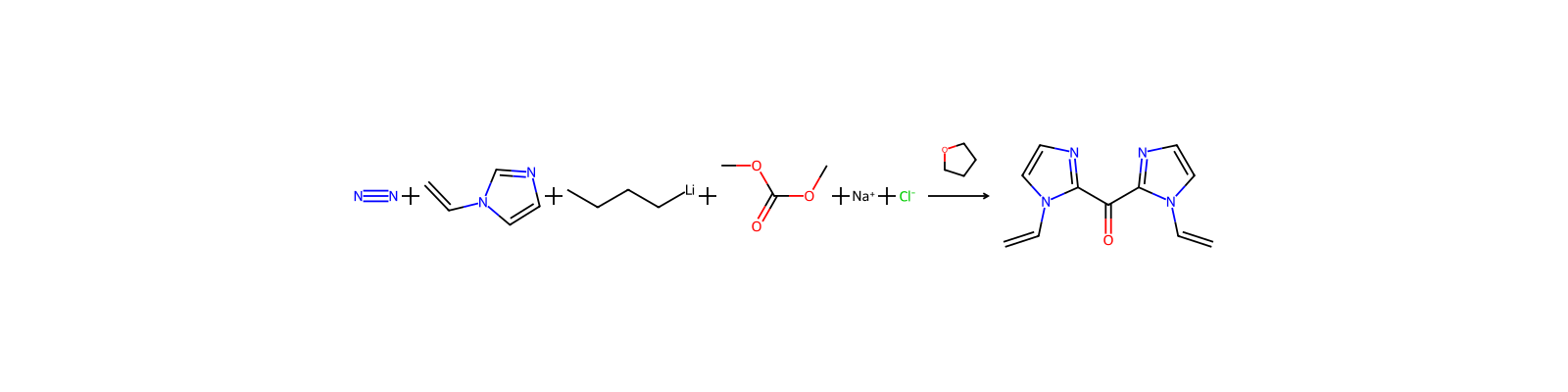
Participants
| Role | Name | HCID | Charge |
|---|
| Reactant | Nitrogen | HCID 947 | — |
| Reactant | Sodium Chloride | HCID 5234 | — |
| Reactant | Dimethyl Carbonate | HCID 12021 | — |
| Reactant | 1-Vinylimidazole | HCID 66171 | — |
| Reactant | Butyllithium | HCID 178418339 | — |
| Solvent | Tetrahydrofuran | HCID 8028 | — |
| Product | HCID 54249201 | HCID 54249201 | — |
Reaction Steps
A flame-dry round-bottom flask with magnetic stir bar is cooled under N2 flow. 180 mLs anhydrous THF is added via canula and positive N2 pressure is established. 7.39 g (78.5 mmol) of 1-vinylimidazole (a light yellow liquid) is added via syringe. The vessel is then cooled to -78° C. by immersion is a CO2 /EtOH bath. Once cool, 32 mLs of 2.5M n-butyllithium is carefully added via syringe. The reaction is allowed to stir for approximately 1 hour while -78° C. is maintained. Meanwhile a second 500 mL flame-dry round-bottom flask is cooled under N2 flow and 100 mLs of anhydrous THF are added to it via canula. Positive N2 pressure is established. This is followed by syringe addition of 3.54 g (39.3 mmol) dimethyl carbonate. The second flask is cooled to -78° C. in a CO2 /EtOH bath. After the 1 hour has elapsed in the first vessel's reaction, the contents of the first flask (a greenish/orange solution) are transferred via canula to the second flask. The transfer is done dropwise over a 1 hour period. No signs of a color change occur in the destination flask. The reaction mixture is allowed to stir overnight while warming to 25° C. In the morning the reaction mixture is quenched by lifting of the septum and adding excess solid CO2. This is done slowly. Yellow solids precipitate out of the solution. The solvents are then removed in vacuo with a 25° C. water bath. The white residue is dissolved in 250 mLs of saturated NaCl solution. Much of the solid residue does not dissolve. The brine solution is filtered through a Buchner funnel to collect the light yellow crystals. The brine solution is then extracted with three aliquots of 100 mLs methylene chloride. The extract is dried over anhydrous sodium sulfate and filtered through a fluted filter. The methylene chloride is removed in vacuo with a 25° C. water bath to leave light yellow crystals. The light yellow crystals are washed with diethyl ether to leave a white solid; or they can be recrystallized from boiling diethyl ether to isolate clear crystals. 1H NMR (300 MHz, CDCl3): δ7.7167, 7.6879, 7.6645, 7.6355 (q, CNH, 2H, J=8,705 Hz and 7.001 Hz), 7.4710, 7.4671 (d, CH, 2H, J=1.16 Hz), 7.3457, 7.3423 (d, CH, 2H, J =1.01 Hz), 5.3940, 5.3888, 5.3418, 5.3365 (d of d, CH2, 2H, J=14.08 Hz and 1.59 Hz), 5.0751, 5.0698, 5.0462, 5.0408 (d of d, CH2, 2H, J=7.08 Hz and 1.59 Hz). 13C NMR (300 MHz, CDCl3): δ6173.9390, 141.9383, 131.3468, 130.9122, 121.2263, 105.4057, IR (NaCl, cm-1): 3167.87-2994.58(m); 1723.84(s); 1660.31(s); 1510.13, 1440.82, 1394.01(m); 1313.75, 1279.09, 1300(m); 1140.46(m); 1094.25(s); 1059.59(s); 967.18,944.07, 886.31(m). M.P.=133.0° C.
Provenance & Evidence
| DOI | 10.6084/m9.figshare.5104873.v1 |
|---|
| Patent number | US05646296 |
|---|
| Source dataset | uspto-grants-1997_07 |
|---|
| ORD ID | ord-43266ed48b0346f592b3157467c3833a |
|---|
| Source note | uspto-grants-1997_07 |
|---|