HuagongsheHuagongshe Chemistry Print Report · For research reference only
HRID 26550Generated: October 26, 2026
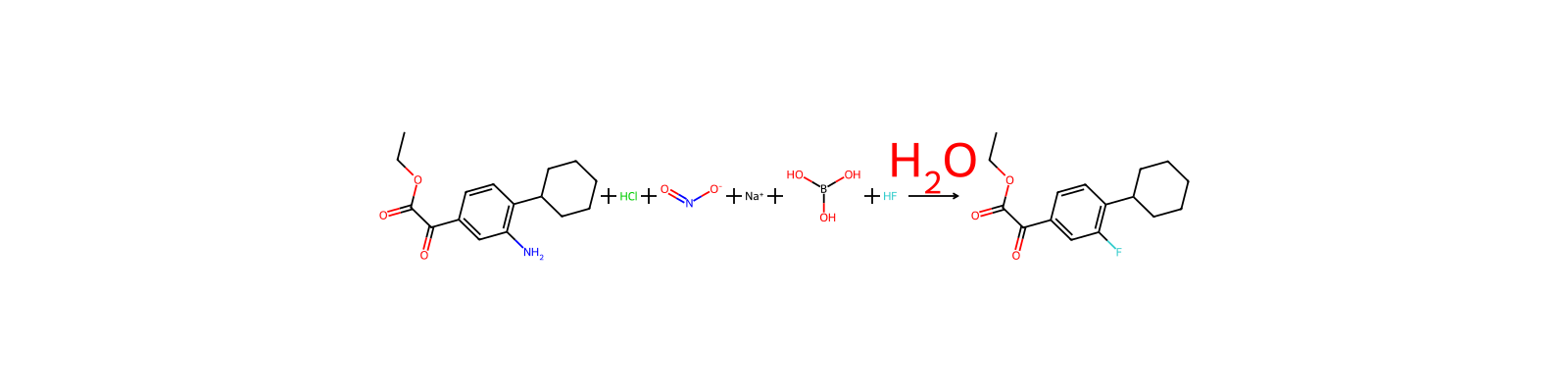
Hydrochloric Acid → Ethyl 3-fluoro-4-cyclohexylphenylglyoxylate
https://huagongshe.com/reaction/26550
Participants
| Role | Name | HCID | Charge |
|---|
| Reactant | Hydrochloric Acid | HCID 313 | — |
| Reactant | Boric Acid | HCID 7628 | — |
| Reactant | Hydrofluoric Acid | HCID 14917 | — |
| Reactant | Ethyl 3-amino-4-cyclohexylphenylglyoxylate | HCID 20515218 | — |
| Reactant | Sodium Nitrite | HCID 23668193 | — |
| Solvent | Water | HCID 962 | — |
| Product | Ethyl 3-fluoro-4-cyclohexylphenylglyoxylate | HCID 20515163 | — |
Reaction Steps
To 44.2 g. (0.15 moles) of ethyl 3-amino-4-cyclohexylphenylglyoxylate is added at 0° C. 44 ml. of 1.5 moles of concentrated hydrochloric acid. The reaction mixture is maintained at 0° C. and the diazonium salt is prepared with 23.2 g. (0.32 moles) of 95% sodium nitrite in 80 ml. of water. To this mixture is rapidly added a solution of 10.4 g. (0.17 moles) of boric acid dissolved in 22 g. (0.66 moles) of 60% hydrofluoric acid. The reaction mixture is then stirred for 1/2 hour and filtered, washed with 3 × 25 ml. of water, 2 × 25 ml. of methanol and 25 ml. of ether. The residual cake is then treated in vacuo. The treated cake is then placed in a distilling flask and heated to permit spontaneous decomposition. After the decomposition, the residue is then fractionally distilled to obtain ethyl 3-fluoro-4-cyclohexylphenylglyoxylate.
Provenance & Evidence
| DOI | 10.6084/m9.figshare.5104873.v1 |
|---|
| Patent number | US04150148 |
|---|
| Source dataset | uspto-grants-1979_04 |
|---|
| ORD ID | ord-13819aa5c15a4278b384dc412c9210ad |
|---|
| Source note | uspto-grants-1979_04 |
|---|