Benzene → N-Trichloroacryloyl-p-aminobenzoic acid
Reaction equation

[Cl:1][C:2]([Cl:8])=[C:3]([Cl:7])[C:4](O)=[O:5].O=S(Cl)Cl.C1C=CC=CC=1.[NH2:19][C:20]1[CH:28]=[CH:27][C:23]([C:24]([OH:26])=[O:25])=[CH:22][CH:21]=1>C(#N)C>[Cl:7][C:3](=[C:2]([Cl:8])[Cl:1])[C:4]([NH:19][C:20]1[CH:28]=[CH:27][C:23]([C:24]([OH:26])=[O:25])=[CH:22][CH:21]=1)=[O:5]Participants
6
Reactant 4

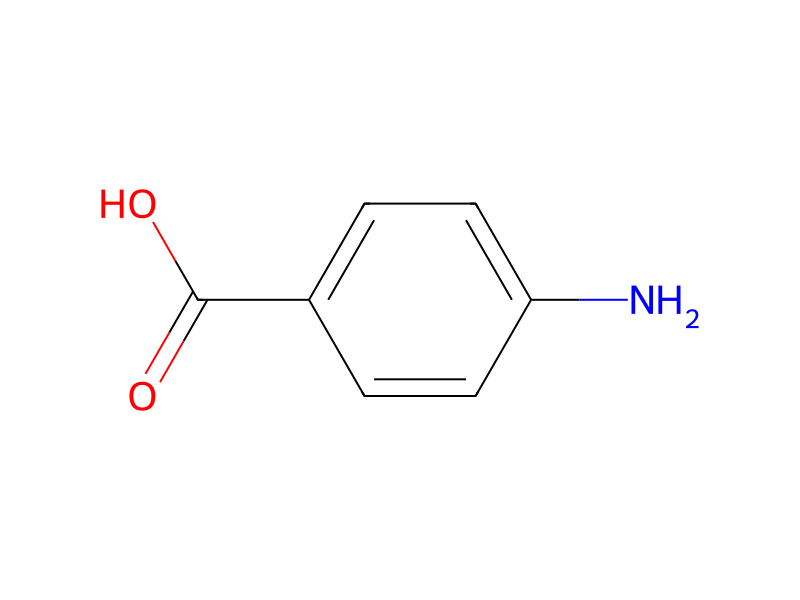


Product 1

Reagents, catalysts & solvents 1

Procedure
Trichloroacrylic acid (500 mg, 2.85 mmol; Alpha Chem. Co.) was added to 7 mL of SOCl2 and the mixture was refluxed for 6 h. After cooling, 5 mL of benzene was added and the solvent was concentrated on the rotary evaporator to 1/3 of its original volume. This step was repeated 4 times, until most of SOCl2 was evaporated. Three mL of acetonitrile were added followed by a suspension of 383 mg (2.80 mmol) of p-amino-benzoic acid in 3 mL of acetonitrile. After 30 min of stirring, TLC showed the disappearance of most starting material and the presence of a product with higher Rf value. The product was purified by preparative silica TLC (EtOAC/Hexane/acetic acid, 2:3:0.05) which gave a pure white powder (89% yield); MS (EI) m/z 293 (M+).
Workup
- temperaturethe mixture was refluxed for 6 h
- temperatureAfter cooling
- concentrationthe solvent was concentrated on the rotary evaporator to 1/3 of its original volume
- customuntil most of SOCl2 was evaporated
- additionThree mL of acetonitrile were added
- customThe product was purified by preparative silica TLC (EtOAC/Hexane/acetic acid, 2:3:0.05) which
Sources & evidence
- ORD record
- ord-2e46a34f713b440687ac179ad1466057
- Source dataset
- uspto-grants-1997_07
- Patent number
- US05650270
Reaction notes
Loading…