Acetonitrile → 4-Aminobenzoic Acid
Reaction equation

ClC(=C(Cl)Cl)C([NH:5][C:6]1[CH:14]=[CH:13][C:9]([C:10]([OH:12])=[O:11])=[CH:8][CH:7]=1)=O.P([O-])([O-])([O-])=O.[K+].[K+].[K+].C(#N)C>CO>[NH2:5][C:6]1[CH:14]=[CH:13][C:9]([C:10]([OH:12])=[O:11])=[CH:8][CH:7]=1Participants
Reactant 3



Product 1
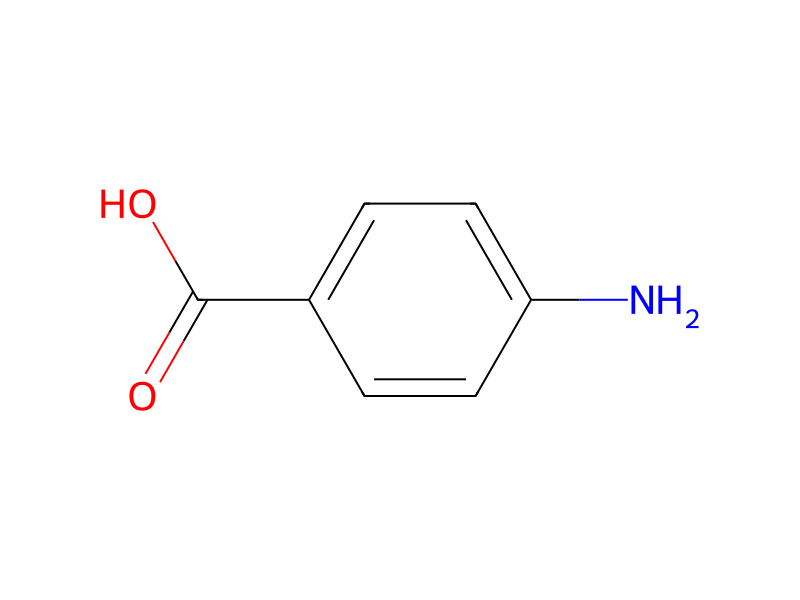
Reagents, catalysts & solvents 1

Procedure
N-Trichloroacryloyl-p-aminobenzoic acid (440 μg) was dissolved in 1 mL of methanol, and 100 μL of this solution was added to 300 μL of potassium phosphate buffer (0.1 M, pH 8). In the same way a solution of p-aminobenzoic acid was prepared. Both solutions were analyzed by HPLC (C18-silica column, 0.01 M potassium phosphate buffer pH 4.5 initially, then 0 to 38% acetonitrile over 29 minutes. This gave a retention time of 6.8 min for p-aminobenzoic acid and 26 min for the product. The solutions were kept at room temperature. Analysis by HPLC demonstrated that the N-trichloroacryloyl-p-aminobenzoic acid was stable at least for four days. By this last day the solution of the p-aminobenzoic acid had discolored and additional peaks were seen.
Workup
- customIn the same way a solution of p-aminobenzoic acid was prepared
Sources & evidence
- ORD record
- ord-3e53379146534db49b785720eb59b4d2
- Source dataset
- uspto-grants-1997_07
- Patent number
- US05650270
Reaction notes
Loading…