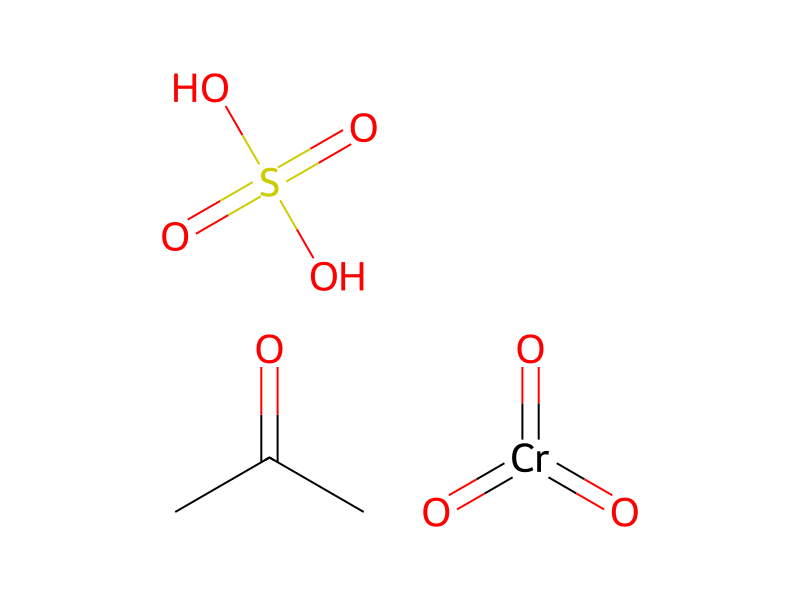
Jones' reagent → Chromium trioxide acetic acid water
Reaction equation

C[C:2]([CH3:4])=[O:3].[OH:5]S(O)(=O)=O.[O:10]=[Cr:11](=O)=O.[Cr](O[Cr]([O-])(=O)=O)([O-])(=O)=[O:15].[Na+].[Na+].S(=O)(=O)(O)[OH:26].[Cr](Cl)([O-])(=O)=O.[NH+]1C=CC=CC=1>>[O-2:3].[O-2:5].[O-2:10].[Cr+6:11].[C:2]([OH:15])(=[O:3])[CH3:4].[OH2:26]Participants


Procedure
The oxidation of the alcohol is carried out using a suitable oxidation agent such as "Jones Reagent", sodium dichromate-sulfuric acid mixture, pyridinium chlorochromate, or a chromium trioxide-acetic acid-water mixture to form the corresponding ketone. The oxidation reaction may be carried out at temperatures between -10° C. and +50° C. When using a Jones Reagent, it is preferred to use a temperature of about -5° C. It is noteworthy that oxidation systems such as dimethyl sulfoxide-acetic anhydride or copper chromite have not given successful oxidations. The resulting ketone may be hydrogenated using, for example, a palladium catalyst or a palladium-on-carbon catalyst, whereby a saturated ketone is formed for example, according to the reaction: ##STR131## or the ketone can be used "as is" for its organoleptic properties. The hydrogenation is preferably carried out at temperatures in the range of from about 20° C. up to 100° C.
Sources & evidence
- ORD record
- ord-7d06e2d7475c46faa74bd4248d03cccb
- Source dataset
- uspto-grants-1979_04
- Patent number
- US04151309
Reaction notes
Loading…