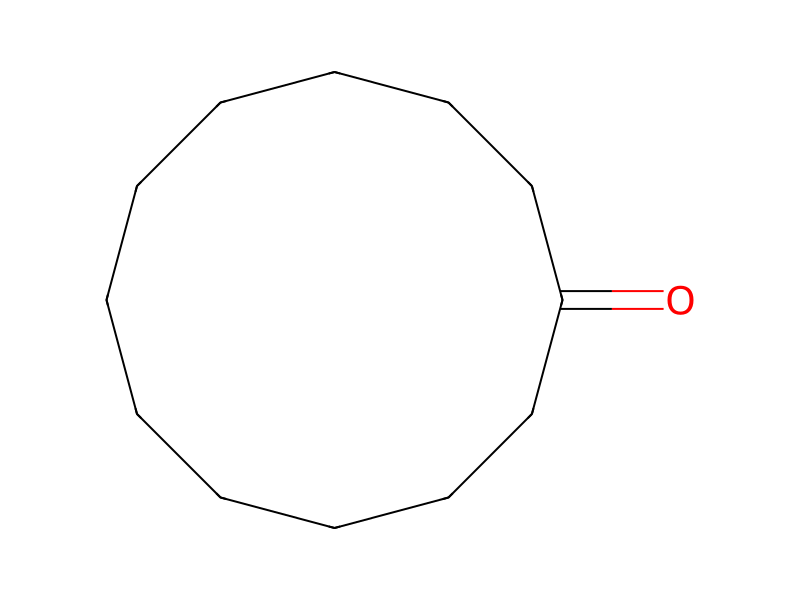
4,8-Cyclododecadien-1-one → Cyclododecanone
Reaction equation

[C:1]1(=[O:13])[CH2:12][CH2:11][CH2:10][CH:9]=[CH:8][CH2:7][CH2:6][CH:5]=[CH:4][CH2:3][CH2:2]1.[H][H]>[Pd]>[C:1]1(=[O:13])[CH2:12][CH2:11][CH2:10][CH2:9][CH2:8][CH2:7][CH2:6][CH2:5][CH2:4][CH2:3][CH2:2]1Participants
Reactant 2


Product 1
Reagents, catalysts & solvents 1

Procedure
50 g of cyclododeca-4,8-dienone (isomer mixture, fraction 2 from Example 4) and 1 g of Pd/C catalyst (10% by weight of Pd, commercially available from Degussa under the product number E 101 N/D) were introduced into a 100 ml autoclave. 5 bar of hydrogen were injected with stirring. At a reaction temperature of 50° C., further hydrogen was supplied (10 h) until no more hydrogen was absorbed. After cooling, decompressing and filtering off the catalyst, the effluent was analyzed by gas chromatography. The conversion of cyclododeca-4,8-dienone was quantitative. Cyclododecanone was obtained in a substantially quantitative yield (>98%). The only impurities which could be detected by GC-MS were traces of cyclododecane, cyclododecenone and dodecanal.
Workup
- custom(10 h)
- customwas absorbed
- temperatureAfter cooling
- filtrationfiltering off the catalyst
Sources & evidence
- ORD record
- ord-058b4f14f2a646f8a5fa571c6fbabc07
- Source dataset
- uspto-grants-2008_11
- Patent number
- US07449606B2
Reaction notes
Loading…