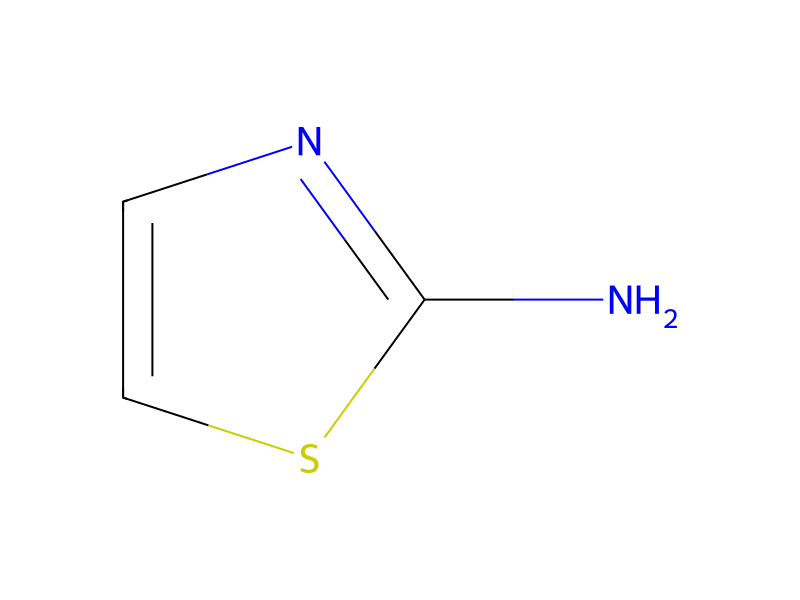
2-Aminothiazole → (E)-3-cycloheptyl-2-(4-methanesulfonyl-phenyl)-N-thiazol-2-yl-acrylamide
Reaction equation

C1(P(C2C=CC=CC=2)C2C=CC=CC=2)C=CC=CC=1.BrN1C(=O)CCC1=O.[CH:28]1(/[CH:35]=[C:36](\[C:40]2[CH:45]=[CH:44][C:43]([S:46]([CH3:49])(=[O:48])=[O:47])=[CH:42][CH:41]=2)/[C:37]([OH:39])=O)[CH2:34][CH2:33][CH2:32][CH2:31][CH2:30][CH2:29]1.[NH2:50][C:51]1[S:52][CH:53]=[CH:54][N:55]=1>C(Cl)Cl>[CH:28]1(/[CH:35]=[C:36](\[C:40]2[CH:45]=[CH:44][C:43]([S:46]([CH3:49])(=[O:48])=[O:47])=[CH:42][CH:41]=2)/[C:37]([NH:50][C:51]2[S:52][CH:53]=[CH:54][N:55]=2)=[O:39])[CH2:29][CH2:30][CH2:31][CH2:32][CH2:33][CH2:34]1Participants
Reactant 4



Product 1

Reagents, catalysts & solvents 1

Conditions
- Temperature
- 0 °C
Procedure
A solution of triphenylphosphine (8.08 g, 30.8 mmol) in methylene chloride (100 mL) was cooled to 0° C. and then treated with N-bromosuccinimide (5.48 g, 30.8 mmol). The reaction mixture was stirred at 0° C. for 30 min and then treated with a solution of (E)-3-cycloheptyl-2-(4-(methanesulfonyl)-phenyl)-acrylic acid (4.97 g, 15.41 mmol) in methylene chloride (20 mL). The clear solution was stirred for 15 min at 0° C. and then allowed to warm to 25° C. where it was stirred for 1.5 h. The reaction mixture was then treated with 2-aminothiazole (4.63 g, 46.23 mmol), and the resulting suspension was stirred for 2 d at 25° C. The reaction mixture was then concentrated in vacuo to remove methylene chloride, and the residue was diluted with ethyl acetate (250 mL) and a 1N aqueous hydrochloric acid solution (150 mL). The two layers were separated, and the aqueous layer was extracted with ethyl acetate (1×150 mL). The combined organic extracts were successively washed with a saturated aqueous sodium bicarbonate solution (1×250 mL) and a saturated aqueous sodium chloride solution (1×200 mL), dried over anhydrous magnesium sulfate, filtered, and concentrated in vacuo. Flash chromatography (Merck Silica gel 60, 230-400 mesh, 5/1 to 3/2 hexanes/ethyl acetate) afforded (E)-3-cycloheptyl-2-(4-methanesulfonyl-phenyl)-N-thiazol-2-yl-acrylamide (2.7 g, 43%) as an amorphous solid. This compound was dissolved in acetonitrile (˜55 mL) and stored overnight at 25° C. The solids were collected by filtration and washed with acetonitrile (5 mL) to obtain (E)-3-cycloheptyl-2-(4-methanesulfonyl-phenyl)-N-thiazol-2-yl-acrylamide (2.1 g, 33%) as a crystalline solid: mp 163-165° C.; EI-HRMS m/e calcd for C20H24N2O3S2 (M+) 404.1253, found 404.1251.
Workup
- stirringThe clear solution was stirred for 15 min at 0° C.
- temperatureto warm to 25° C. where it
- stirringwas stirred for 1.5 h
- stirringthe resulting suspension was stirred for 2 d at 25° C
- concentrationThe reaction mixture was then concentrated in vacuo
- customto remove methylene chloride
- additionthe residue was diluted with ethyl acetate (250 mL)
- customThe two layers were separated
- extractionthe aqueous layer was extracted with ethyl acetate (1×150 mL)
- washThe combined organic extracts were successively washed with a saturated aqueous sodium bicarbonate solution (1×250 mL)
- dry with materiala saturated aqueous sodium chloride solution (1×200 mL), dried over anhydrous magnesium sulfate
- filtrationfiltered
- concentrationconcentrated in vacuo
Sources & evidence
- ORD record
- ord-cbe42c51d32a45b385bbe44be6c8b056
- Source dataset
- uspto-grants-2002_03
- Patent number
- US06353111B1
Reaction notes
Loading…