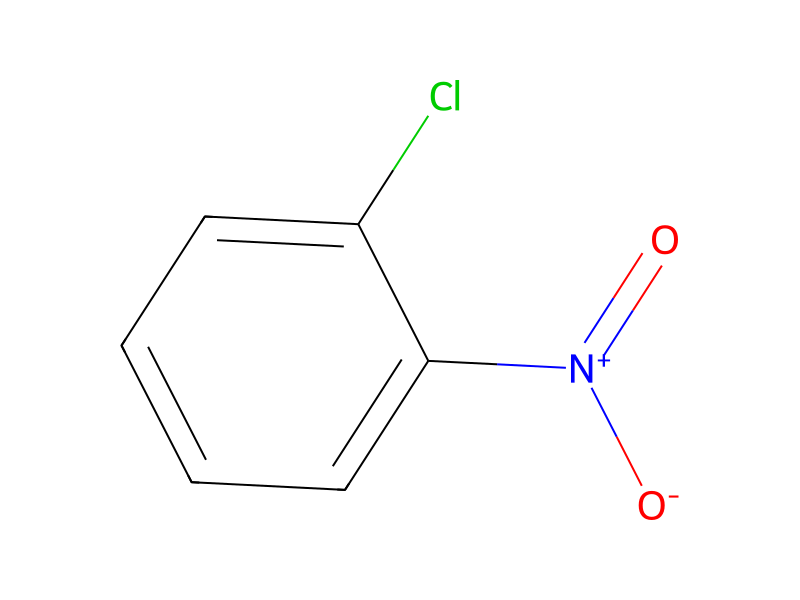
Benzene → 2-Nitrophenylphenyl ether
Reaction equation

Cl[C:2]1[CH:7]=[CH:6][CH:5]=[CH:4][C:3]=1[N+:8]([O-:10])=[O:9].[C:11]1(O)[CH:16]=[CH:15][CH:14]=[CH:13][CH:12]=1.[C:18](=[O:21])([O-])[O-].[K+].[K+].[CH:24]1[CH:29]=[CH:28][CH:27]=[CH:26][CH:25]=1>[Cu].CC(N(C)C)=O>[N+:8]([C:3]1[CH:4]=[CH:5][CH:6]=[CH:7][C:2]=1[C:11]1[CH:16]=[CH:15][CH:14]=[CH:13][C:12]=1[O:21][C:18]1[CH:6]=[CH:7][CH:2]=[CH:3][C:4]=1[C:24]1[CH:29]=[CH:28][CH:27]=[CH:26][C:25]=1[N+:8]([O-:10])=[O:9])([O-:10])=[O:9]Participants
Reactant 4


Product 1

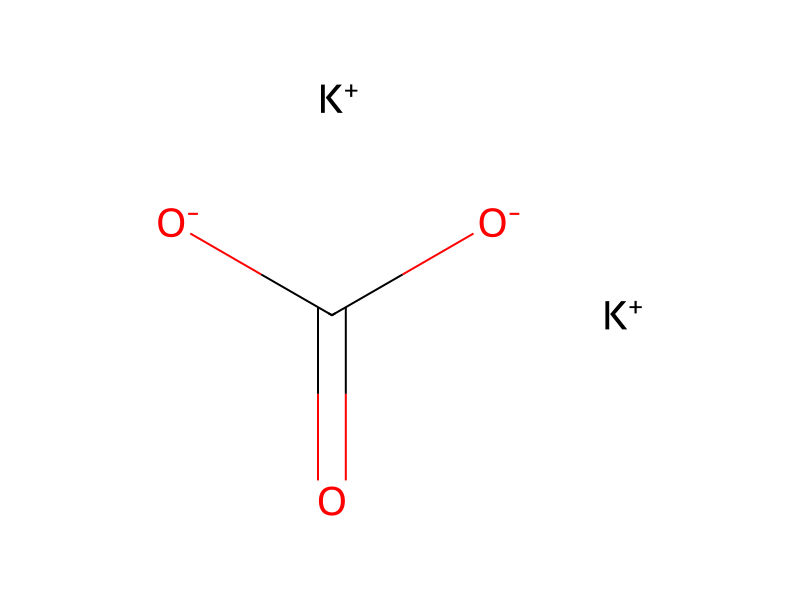
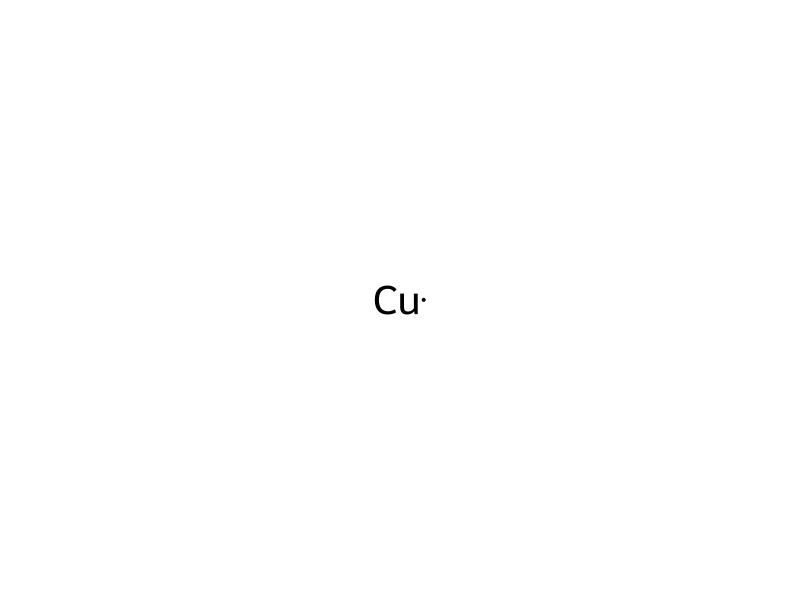
Reagents, catalysts & solvents 2

Procedure
In accordance with this sequence, a 1-chloro-2-nitrobenzene (5) is reacted with a phenol (6) a base such as potassium carbonate and activated copper where necessary in a solvent such as benzene of dimethyl acetamide with heat giving a 2-nitrophenylphenyl ether (7). This ether (7) is then reduced by conventional means (i.e. sodium hydrosulfite) to the phenoxyaniline (8). Isonicotinic acid is reacted with a mineral acid halide such as thionyl chloride heat or by heating at reflux in methylene chloride. The volatiles are evaporated and the residue is reacted with the phenoxyaniline (8) and a base such as triethylamine or potassium carbonate in a solvent such as tetrahydrofuran or benzene at a temperature from 25° to 80° for several hours giving a phenoxy-isonicotinanilide (9). This compound (9) is then reacted with phosphorous pentoxide and phosphorous oxychloride at reflux for several hours. The residue is reacted with ammonium hydroxide in ice and extracted in methylene chloride giving an 11-(4-pyridyl)-di-benz[b,f][1,4]oxazepine (10). This oxazepine (10) is then reacted with an alkyl halide in a solvent such as acetone or methylene chloride to produce (1), where R is as hereinbefore described which is the immediate precursor to the aforementioned anti-psychotic agents. To produce the 10,11-dihydro-11-(4-pyridyl)-dibenz[b,f][1,4]oxazepine (11), the compound (10), is treated with a reducing agent such as an alkali aluminum hydride in a solvent such as ether or benzene at reflux, quenched with water and extracted with methylene chloride. To produce the 10-alkyl-10,11-dihydro-11-(4-pyridyl)-dibenz[b,f][1,4]oxazepine (11), the compound (10) is dissolved in an alkanoic acid and treated with sodium borohydride. The compound (11) may be converted to the precursor (2) by reactions with an alkyl halide where R is as described above for compound (10).
Workup
- temperaturewith heat
Sources & evidence
- ORD record
- ord-cd6ddb2096b64b5999c9bccf8fdc4634
- Source dataset
- uspto-grants-1980_09
- Patent number
- US04221715
Reaction notes
Loading…