3-Iodoheptane → (4S)-2-(2-methyl-4-nitrophenylimino)-4-isobutyl-3-(5-heptyl)-1,3-thiazolidine
Reaction equation

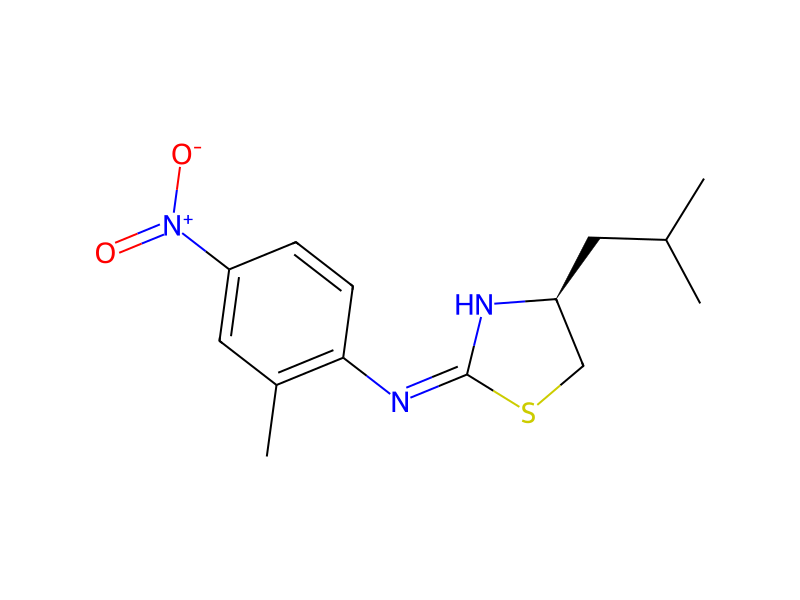
[CH3:1][C:2]1[CH:7]=[C:6]([N+:8]([O-:10])=[O:9])[CH:5]=[CH:4][C:3]=1[N:11]=[C:12]1[NH:16][C@@H:15]([CH2:17][CH:18]([CH3:20])[CH3:19])[CH2:14][S:13]1.I[CH:22]([CH2:27][CH3:28])[CH2:23][CH2:24][CH2:25][CH3:26]>>[CH3:1][C:2]1[CH:7]=[C:6]([N+:8]([O-:10])=[O:9])[CH:5]=[CH:4][C:3]=1[N:11]=[C:12]1[N:16]([CH:22]([CH2:27][CH3:28])[CH2:23][CH2:24][CH2:25][CH3:26])[C@@H:15]([CH2:17][CH:18]([CH3:20])[CH3:19])[CH2:14][S:13]1Participants
3


Procedure
(1S)-(Hydroxymethyl)-3-methylbutylamine was made from (L)-leucine methyl ester as described in Method B1b. The 2-hydroxyethylamine was converted to (1S)-1-(chloromethyl)-1-methylbutanammonium chloride as described in Method B7a. 2-Methyl-4-nitrophenyl isothiocyanate was reacted with (1S)-1-(chloromethyl)-3-methylbutanammonium chloride according to Method C1a to give (4S)-2-(2-methyl-4-nitrophenylimino)-4-isobutyl-1,3-thiazolidine. The thiazolidine was reacted with 5-iodoheptane according to Method D2a to give (4S)-2-(2-methyl-4-nitrophenylimino)-4-isobutyl-3-(5-heptyl)-1,3-thiazolidine.
Sources & evidence
- ORD record
- ord-89926a4f9c51403b804a3179cb19a5d4
- Source dataset
- uspto-grants-2002_03
- Patent number
- US06353006B1
Reaction notes
Loading…