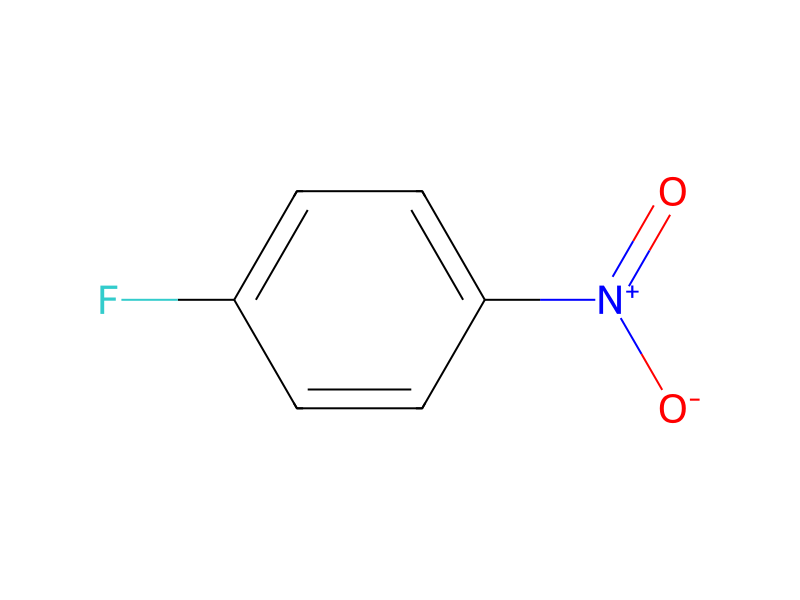
p-Fluoronitrobenzene → 2-(4-nitrophenyl)-2h-1,2,3-triazole
Reaction equation

F[C:2]1[CH:7]=[CH:6][C:5]([N+:8]([O-:10])=[O:9])=[CH:4][CH:3]=1.[NH:11]1[CH:15]=[CH:14][N:13]=[N:12]1>O>[N+:8]([C:5]1[CH:6]=[CH:7][C:2]([N:12]2[N:13]=[CH:14][CH:15]=[N:11]2)=[CH:3][CH:4]=1)([O-:10])=[O:9]Participants
4
Reactant 2

Product 1

Reagents, catalysts & solvents 1

Procedure
4-Fluoronitrobenzene (21 g) was reacted with 1H-1,2,3-triazole (12.4 g) in the same manner as in Reference Example 9. The resultant was cooled and poured into water. The precipitated crystals were collected by filtration and purified by silica gel chromatography (eluent: dichloromethane to dichloromethane/acetone=8/1). The first eluted fraction was recrystallized from dichloromethane-diisopropyl ether to give 2-(4-nitrophenyl)-2H-1,2,3-triazole (18.8 g) as pale yellow prisms.
Workup
- temperatureThe resultant was cooled
- filtrationThe precipitated crystals were collected by filtration
- custompurified by silica gel chromatography (eluent: dichloromethane to dichloromethane/acetone=8/1)
- customThe first eluted fraction was recrystallized from dichloromethane-diisopropyl ether
Sources & evidence
- ORD record
- ord-fbd7cc109d7e47a9a9616d1326ba7ffc
- Source dataset
- uspto-grants-2002_03
- Patent number
- US06362206B1
Reaction notes
Loading…