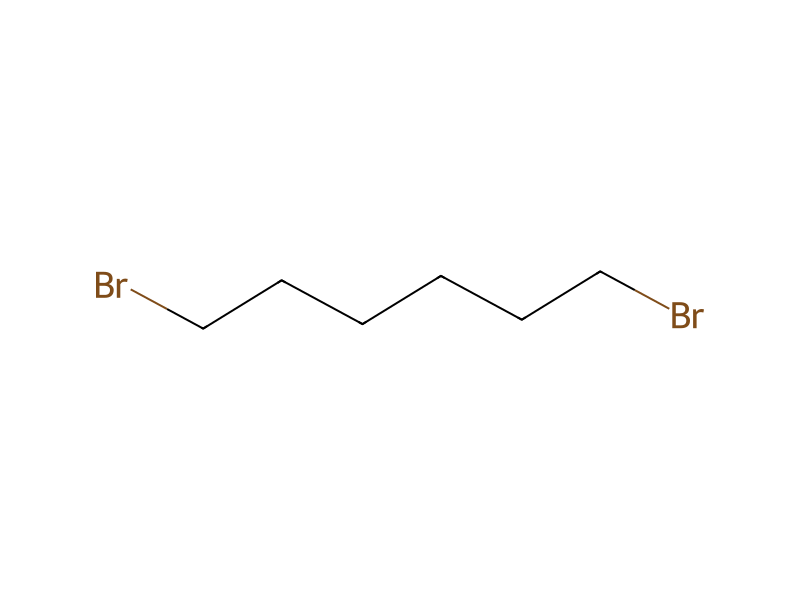
1,6-Dibromohexane → Methyl 10-bromo-4-thia-decanoate
Reaction equation

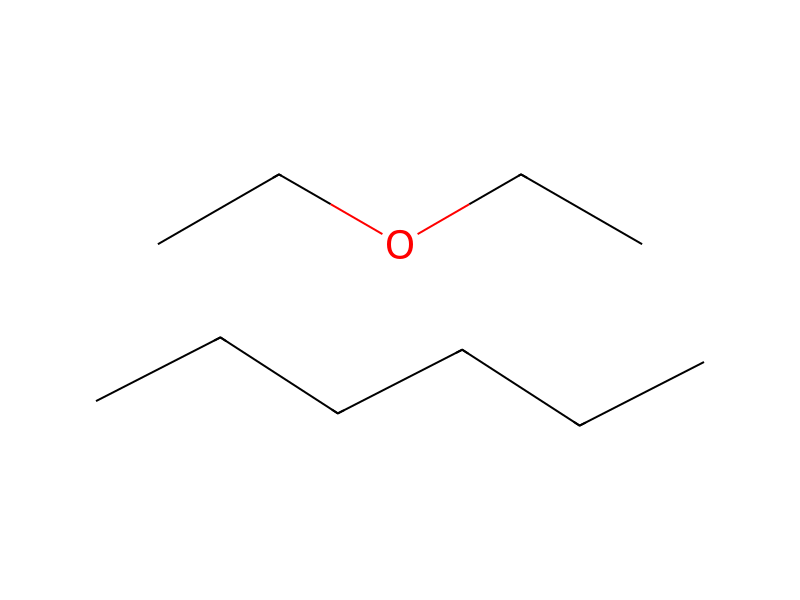
Br[CH2:2][CH2:3][CH2:4][CH2:5][CH2:6][CH2:7][Br:8].[SH:9][CH2:10][CH2:11][C:12]([O:14][CH3:15])=[O:13].ICCCCCCCCCCCCSCCC(OC)=O>CCCCCC.CCOCC>[Br:8][CH2:7][CH2:6][CH2:5][CH2:4][CH2:3][CH2:2][S:9][CH2:10][CH2:11][C:12]([O:14][CH3:15])=[O:13]Participants
5


Procedure
1,6-dibromo-hexane (1.6 g. 13 mmol) and methyl 3-mercapto-propionate (13 mmol) were caused to react according to the procedure for compound 1. The product 5 (1.3 g, 35% yield) was isolated as an oil by column chromatography (hexane/ether 1:1). TL (hexanelether 1:1) Rf=0.6. 1H-NMR δ1.4 (m, 12H, CH2), 2.52 (t, 2H, C(2)H2), 2.61 (t, 2H, C(5)H2), 2.8 (t, 2H, C(3)H2), 3.40 (t, 2H, C(10)H2), 3.7 (s, 3H, COO—CH3).
Workup
- customto react
Sources & evidence
- ORD record
- ord-5fe16a5943834169b0465312dbbed1d1
- Source dataset
- uspto-grants-2002_03
- Patent number
- US06362352B1
Reaction notes
Loading…