Carbon Dioxide → HCID 15075827, compound
Reaction equation

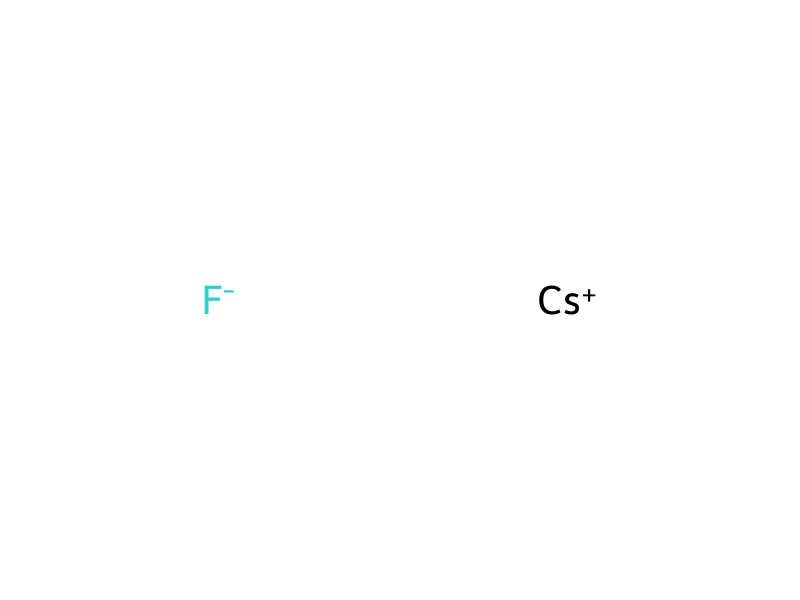
Br[C:2]1[C:7]([CH3:8])=[C:6]([F:9])[C:5]([F:10])=[C:4]([Si:11]([CH3:14])([CH3:13])[CH3:12])[C:3]=1[F:15].C([Li])CCC.[C:21](=[O:23])=[O:22].[F-].[Cs+]>C(#N)C>[F:15][C:3]1[C:4]([Si:11]([CH3:14])([CH3:13])[CH3:12])=[C:5]([F:10])[C:6]([F:9])=[C:7]([CH3:8])[C:2]=1[C:21]([OH:23])=[O:22]Participants
Reactant 4



Product 1

Reagents, catalysts & solvents 1

Procedure
This preparation route is very expensive. The first and the second synthesis step each involve reaction with butyllithium and diisopropylamine in tetrahydrofuran at −78° C., and the third synthesis step involves reaction with butyllithium in ether, likewise at −78° C. In the first step, 1-bromo-2,4,5-trifluorobenzene is reacted first with lithium diisopropylamide and then with trimethylsilyl chloride, the resulting 1-bromo-2,4,5-trifluoro-3-(trimethylsilyl)benzene (88% yield) is once more reacted with lithium diisopropylamide and subsequently with methyl trifluoromethanesulfonate, the resulting 1-bromo-2,4,5-trifluoro-6-methyl-3-(trimethylsilyl)benzene (75% yield) is reacted with butyllithium and subsequently with CO2 in the form of dry ice, and the resulting 2,4,5-trifluoro-6-methyl-3-(trimethylsilyl)- benzoic acid (62% yield) is reacted with cesium fluoride in acetonitrile to give 6-methyl-2,4,5-trifluorobenzoic acid (89% yield).
Sources & evidence
- ORD record
- ord-5f5e4e87a87d41e4ad18e8cde9f10ea1
- Source dataset
- uspto-grants-2002_03
- Patent number
- US06362365B1
Reaction notes
Loading…