Dimethylamine → 6-Bromo-N,N,4-trimethylquinolin-2-amine
Reaction equation

[Br:1][C:2]1[CH:3]=[C:4]2[C:9](=[CH:10][CH:11]=1)[N:8]=[C:7](Cl)[CH:6]=[C:5]2[CH3:13].[CH3:14][NH:15][CH3:16]>C(O)C>[Br:1][C:2]1[CH:3]=[C:4]2[C:9](=[CH:10][CH:11]=1)[N:8]=[C:7]([N:15]([CH3:16])[CH3:14])[CH:6]=[C:5]2[CH3:13]Participants
Reactant 2
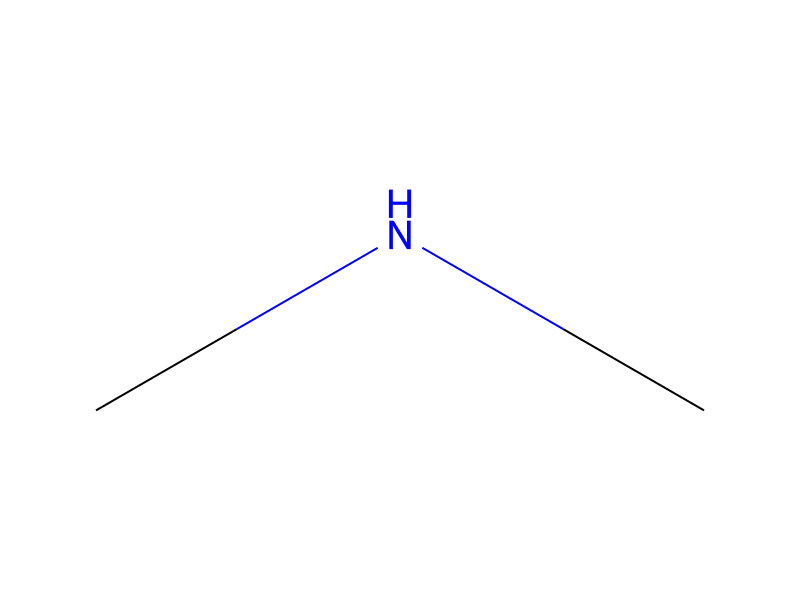

Product 1

Reagents, catalysts & solvents 1

Conditions
- Temperature
- -78 °C
Procedure
A solution of 0.26 g (0.00101 mole) of 6-bromo-2-chloro-4-methylquinoline in 50 ml absolute ethanol was placed in a glass bomb liner, cooled to -78° C., and 7.19 g (0.159 mole) of dimethylamine bubbled into the cold ethanolic solution. The mixture was heated to 112° in a sealed autoclave for 3 hours. The solvent and excess dimethylamine were then removed under vacuum, to leave 0.36 g of residue, which was washed with 40 ml H2O to remove the (CH3)2NH.HCl. The product was then taken up in 40 ml absolute ethanol, treated with Norite A alkaline decolourising carbon and filtered through Celite followed by concentration and addition of 7 ml H2O to induce crystallisation after chilling, the product collected was a light yellow crystalline solid, 0.20 g (74.3%), m.p. 81.9°-84.1° C., and Rf 0.11 on silica with 1:1 CH2Cl2 :hexane.
Workup
- temperatureThe mixture was heated to 112° in a sealed autoclave for 3 hours
- customThe solvent and excess dimethylamine were then removed under vacuum
Sources & evidence
- ORD record
- ord-80afe90706484f93a1ae02cfb1d31a8f
- Source dataset
- uspto-grants-1986_05
- Patent number
- US04587341
Reaction notes
Loading…