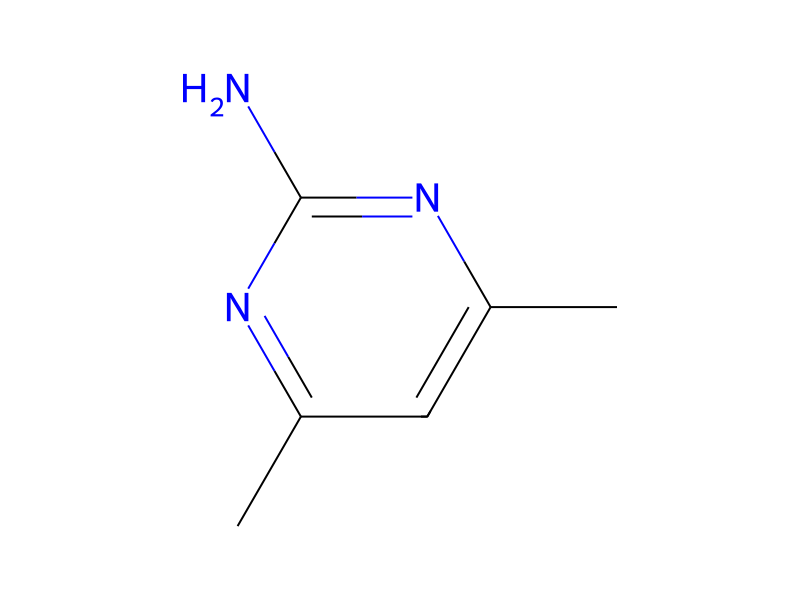
2-Amino-4,6-dimethyl pyrimidine → HCID 13645991, compound
Reaction equation

[CH3:1][C:2]1[CH:7]=[C:6]([CH3:8])[N:5]=[C:4]([NH2:9])[N:3]=1.[CH3:10][Se:11][C:12]1[CH:17]=[CH:16][CH:15]=[CH:14][C:13]=1[S:18]([N:21]=[C:22]=[O:23])(=[O:20])=[O:19]>ClCCl>[CH3:1][C:2]1[CH:7]=[C:6]([CH3:8])[N:5]=[C:4]([NH:9][C:22]([NH:21][S:18]([C:13]2[CH:14]=[CH:15][CH:16]=[CH:17][C:12]=2[Se:11][CH3:10])(=[O:19])=[O:20])=[O:23])[N:3]=1Participants
Reactant 2

Product 1

Reagents, catalysts & solvents 1

Procedure
To a slurry of 4,6-dimethyl-2-pyrimidinamine (0.36 g, 29 mmol) in dry dichloromethane (5 mL) was added a solution of 2-(methylselenyl)benzenesulfonyl isocyanate (1.5 g, crude, 4.2 mmol) in dichloromethane (5 mL). The heterocycle dissolved. The solution was heated at reflux for two hours and stirred at room temperature overnight. The solution was filtered and rotary evaporated to give 1.7 g of yellow solid. This was dissolved in dichloromethane and chromatographed on a column of silica gel using as eluant 320 mL of 15:1, 220 mL of 10:1, 230 mL of 7.5:1, and finally 240 mL of 5:1 dichloromethane-ether, all with 2 mL/L acetic acid. The appropriate fractions were diluted with toluene and rotary evaporated. The residue was dissolved in dichloromethane, diluted with 1-chlorobutane, and rotary evaporated to give a white crystalline solid. This was slurried in hexanes, collected, rinsed with 1-chlorobutane, 1:1 1-chlorobutanehexanes, and hexanes and air dried. The product was isolated as 1.03 g of small white crystalline plates, melting at 205°-207° C. with decomposition.
Workup
- temperatureThe solution was heated
- temperatureat reflux for two hours
- filtrationThe solution was filtered
- customrotary evaporated
Sources & evidence
- ORD record
- ord-4dfda201352643398105b4c0982a351a
- Source dataset
- uspto-grants-1986_05
- Patent number
- US04588432
Reaction notes
Loading…