Formaldehyde → 3-hydroxymethyl-5-(4-pyridinyl)-2(1H)-pyridinone
Reaction equation
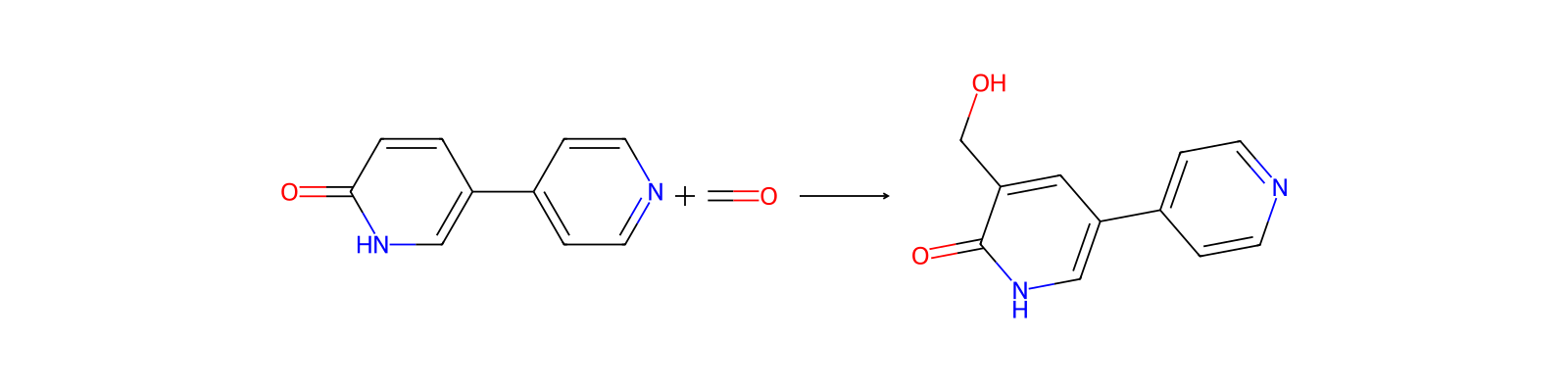
[N:1]1[CH:6]=[CH:5][C:4]([C:7]2[CH:8]=[CH:9][C:10](=[O:13])[NH:11][CH:12]=2)=[CH:3][CH:2]=1.[CH2:14]=[O:15]>>[OH:15][CH2:14][C:9]1[C:10](=[O:13])[NH:11][CH:12]=[C:7]([C:4]2[CH:5]=[CH:6][N:1]=[CH:2][CH:3]=2)[CH:8]=1Participants



Procedure
The reaction of 5-(4-pyridinyl)-2(1H)-pyridinone with excess formaldehyde at an acidic pH to produce 3-hydroxymethyl-5-(4-pyridinyl)-2(1H)-pyridinone is carried out by heating the reactants at about 75° to 125° C. It is preferably run using an acidic pH of about 2.0 to 5.0, a large molar excess of formaldehyde and a reaction temperature of about 90° to 110° C. The quantity of formaldehyde can vary widely provided it is in excess of said 5-(4-pyridinyl)-2(1H)-pyridinone. In practice, a large excess, e.g., from about 10-fold to 100-fold or greater can be used; however, as little as a 2-fold excess or less of formaldehyde can be used although the reaction time is longer. Because of its ready availability and low cost, 37% aqueous formaldehyde solution is preferred.
Sources & evidence
- ORD record
- ord-861cbc3568f94a46a1e1707ace3112e9
- Source dataset
- uspto-grants-1980_09
- Patent number
- US04225601
Reaction notes
Loading…