Soman → (S)-3-methyl-hex-4-enoic acid ethyl ester
Reaction equation
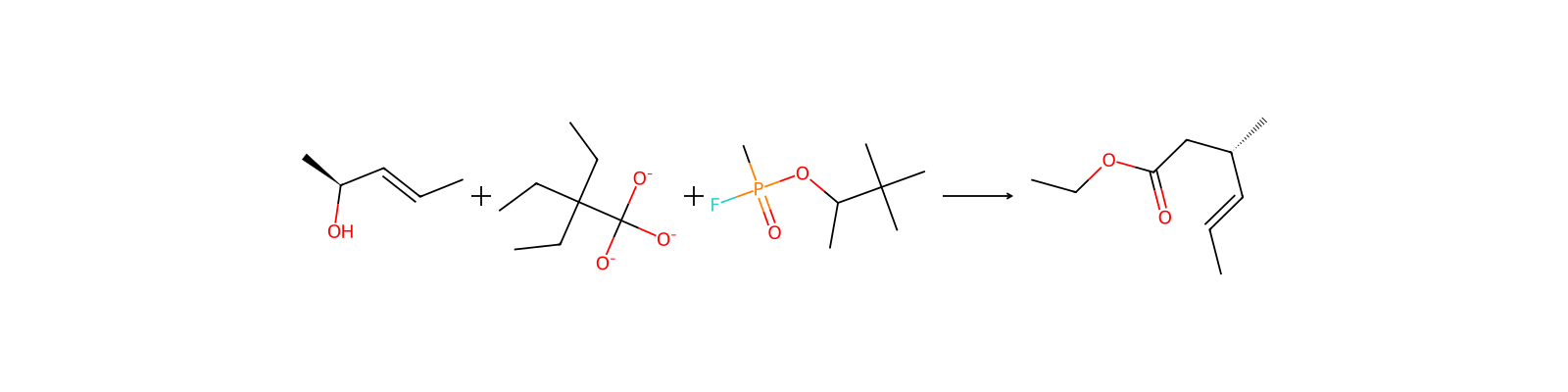
C[C@H:2]([OH:6])/[CH:3]=[CH:4]/[CH3:5].C([C:9]([CH2:16][CH3:17])(CC)C([O-])([O-])[O-])C.CP(=O)(F)[O:20][CH:21](C)[C:22](C)(C)C>>[CH2:21]([O:20][C:2](=[O:6])[CH2:3][C@H:4]([CH3:5])[CH:17]=[CH:16][CH3:9])[CH3:22]Participants


Procedure
To a solution of (S)-3-methyl-hex-4-enoic acid ethyl ester* (1.0 g, 6.4 mmol) in 30 mL toluene at −78° C. was added DIBAH (1.0 M in THF, 6.4 mL) dropwise over 5 min. The mixture was stirred at −78° C. 45 min at which time 5 drops of methanol were added, resulting in vigorous H2 evolution. Methanol was added until no more gas evolution was observed (ca. 5 mL). At this time the cold bath was removed and ca. 5 mL of sat. aq. Na+K+ tartrate was added. When the mixture reached room temperature, additional sat. aq. Na+K+ tartrate and Et2O were added and stirring was continued until the phases were mostly clear (ca. 1 h). The phases were separated, and the organic phase washed with brine, dried (MgSO4), and concentrated to ca. 10 mL total volume owing to volatility concerns. The crude mixture was combined with an additional batch of aldehyde prepared from 10 mmol of the ester by the method described above and the whole used without purification. To a suspension of sodium hydride (60% dispersion in mineral oil) in 25 mL THF was added t-butyl-P, P-dimethylphosphonoacetate (3.0 mL, 15 mmol) dropwise over 1 h such that the evolution of H2 was under control. After the addition was complete, the crude aldehyde in toluene (ca. 20 mL total volume) was added quickly dropwise and the mixture stirred at ambient temperature overnight. The mixture was partitioned between Et2O and sat. aq. NH4Cl, the phases separated, the organic phase washed with brine, dried (MgSO4), and concentrated. Flash chromatography of the residue (0→3→5% EtOAc/hexanes) afforded 1.0 g (29%, two steps) of the unsaturated ester as a pale yellow oil: 1H NMR(CDCl3) δ 6.75 (m, 1H), 5.66 (m, 1H), 5.30 (m, 2H), 2.03-2.29 (m, 3H), 1.58 (d, J=6.1 Hz, 3H), 1.41 (s, 9H), 0.91 (d, J=6.6 Hz, 3H). *(S)-3-methyl-hex-4-enoic acid ethyl ester was prepared from (S)-trans-3-Penten-2-ol [Liang, J.; Hoard, D. W.; Van Khau, V.; Martinelli, M. J.; Moher, E. D.; Moore, R. E.; Tius, M. A. J. Org. Chem., 1999, 64, 1459] via Johnson-Claisen rearrangement with triethylorthoacetate according to the literature protocol [Hill, R. K.; Soman, R.; Sawada, S., J. Org. Chem., 1972, 37, 3737].
Sources & evidence
- ORD record
- ord-a0dfabf58789490eab449449ab1fa351
- Source dataset
- uspto-grants-2008_09
- Patent number
- US07419981B2
Reaction notes
Loading…