HuagongsheHuagongshe Chemistry Print Report · For research reference only
HRID 31415Generated: October 25, 2026
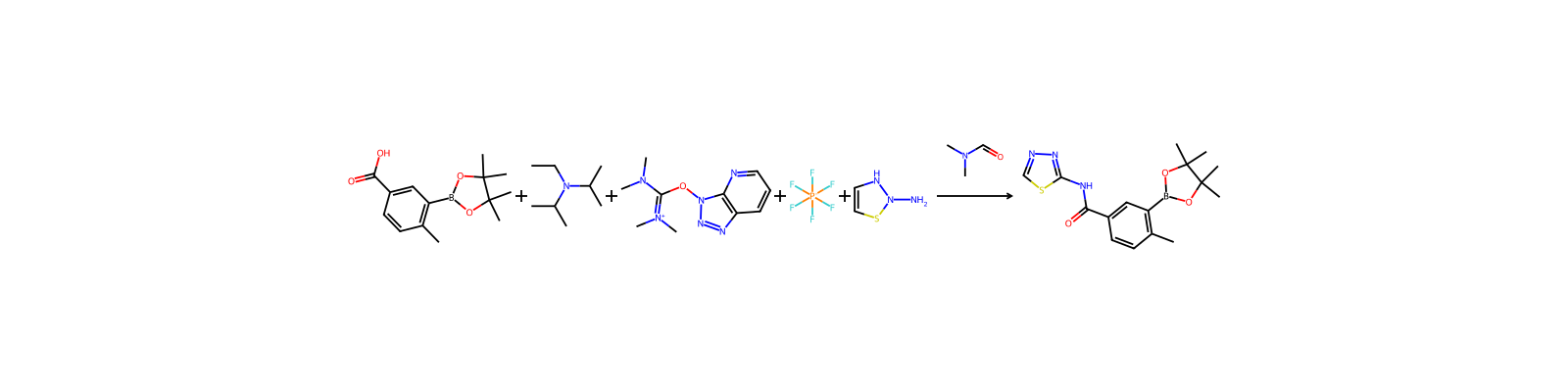
Diisopropylethylamine → 4-methyl-3-(4,4,5,5-tetramethyl-[1,3,2]dioxaborolan-2-yl)-N-([1,3,4]thiadiazol-2-yl)-benzamide
https://huagongshe.com/reaction/31415
Participants
| Role | Name | HCID | Charge |
|---|
| Reactant | Diisopropylethylamine | HCID 81531 | — |
| Reactant | Methanaminium, N-((dimethylamino)(3H-1,2,3-triazolo(4,5-b)pyridin-3-yloxy)methylene)-N-methyl-, hexafluorophosphate(1-) (1:1) | HCID 9886157 | — |
| Reactant | 4-Methyl-3-(tetramethyl-1,3,2-dioxaborolan-2-yl)benzoic acid | HCID 16086086 | — |
| Reactant | 3H-thiadiazol-2-amine | HCID 21914578 | — |
| Solvent | Dimethylformamide | HCID 6228 | — |
| Product | 4-methyl-3-(4,4,5,5-tetramethyl-[1,3,2]dioxaborolan-2-yl)-N-([1,3,4]thiadiazol-2-yl)-benzamide | HCID 58656532 | 36.1% |
Reaction Steps
4-Methyl-3-(4,4,5,5-tetramethyl-[1,3,2]dioxaborolan-2-yl)-benzoic acid (Intermediate 21) (2.0 g, 7.63 mmol), DIPEA (4 ml, 22.89 mmol) and HATU (3.05 g, 8.02 mmol) were dissolved in DMF (20 ml) and stirred at room temperature for 15 mins. 2-Aminothiadiazole (810 mg, 8.01 mmol) was added and the reaction stirred at room temperature for 18 hours. The solvent was evaporated under vacuum and the reaction partitioned between ethyl acetate (250 ml) and hydrochloric acid (2N, 150 ml). The aqueous phase was extracted with ethylacetate (2×250 ml). The combined organic extracts were dried (magnesium sulphate) and the solvent evaporated under vacuum. The residue was absorbed onto silica and purified by flash column chromatography eluting with cyclohexane/ethyl acetate (4:1 then 1:1). The solvent was evaporated from the product fractions under vacuum to give 4-methyl-3-(4,4,5,5-tetramethyl-[1,3,2]dioxaborolan-2-yl)-N-([1,3,4]thiadiazol-2-yl)-benzamide (0.95 g).
Provenance & Evidence
| DOI | 10.6084/m9.figshare.5104873.v1 |
|---|
| Patent number | US07425555B2 |
|---|
| Source dataset | uspto-grants-2008_09 |
|---|
| ORD ID | ord-d71d058c0ad34cd4b0dd5b87d3d4c68a |
|---|
| Source note | uspto-grants-2008_09 |
|---|