4-Methylmorpholine → [4-(4-Methylpiperazinylmethyl)-2-phenylbenzoyl]methionine methyl ester
Reaction equation

CO[C:3](=[O:18])[C:4]1[CH:9]=[CH:8][C:7]([CH2:10]Cl)=[CH:6][C:5]=1[C:12]1[CH:17]=[CH:16][CH:15]=[CH:14][CH:13]=1.[CH3:19][N:20]1[CH2:25][CH2:24][NH:23][CH2:22][CH2:21]1.C([O-])([O-])=O.[K+].[K+].Cl.[NH2:33][C@H:34]([C:39]([O:41][CH3:42])=[O:40])[CH2:35][CH2:36][S:37][CH3:38].ON1C(=O)C2C=CC=CC=2N=N1.CN(C)CCCN=C=NCC.CN1CCOCC1>[N+](CCCC)(CCCC)(CCCC)CCCC.[Br-].CN(C=O)C.C(OCC)(=O)C.CO.C(OCC)(=O)C>[CH3:42][O:41][C:39](=[O:40])[C@H:34]([CH2:35][CH2:36][S:37][CH3:38])[NH:33][C:3](=[O:18])[C:4]1[CH:9]=[CH:8][C:7]([CH2:10][N:23]2[CH2:24][CH2:25][N:20]([CH3:19])[CH2:21][CH2:22]2)=[CH:6][C:5]=1[C:12]1[CH:13]=[CH:14][CH:15]=[CH:16][CH:17]=1Participants
Reactant 7
 HCID 79724-Methylmorpholine
 HCID 11430Potassium Carbonate
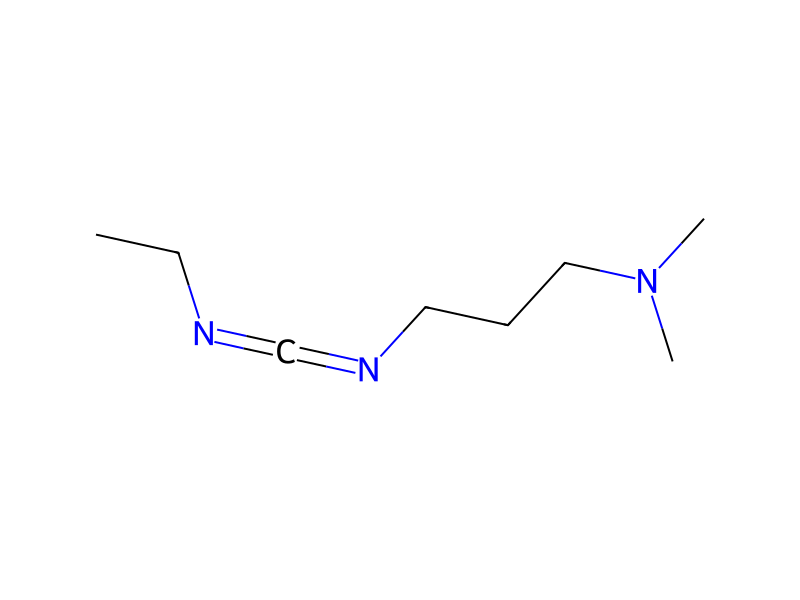 HCID 159081-Ethyl-3-(3'-dimethylaminopropyl)carbodiimide
 HCID 531671-Methylpiperazine
 HCID 730263-hydroxy-1,2,3-benzotriazin-4(3H)-one
 HCID 11435579L-Methionine, methyl ester, hydrochloride
 HCID 544945664-Chloromethyl-2-phenylbenzoic acid methyl ester
Product 1

Reagents, catalysts & solvents 4




Procedure
A solution of 4-chloromethyl-2-phenylbenzoic acid methyl ester (0.521 g, 2.00 mmol), prepared as in Example 286A, 1-methylpiperazine (0.607 g, 6.00 mmol), K2CO3 (0.663 g, 4.80 mmol), KI (0.332 g, 2.00 mmol), and Bu4NBr (0.032 g, 0.10 mmol) in DMF (5 mL) was stirred for 2 hours at ambient temperature and then concentrated under reduced pressure. The residue was treated with a saturated LiOH-methanol (10 mL) and then heated at reflux for 5 hours. The mixture was concentrated and the residue was dissolved in H2O. This solution was extracted with ethyl acetate (5×), and the aqueous phase was then acidified by the addition of 3 M HCl and lyopholized. The resulting white foam was dissolved in DMF (20 mL) and the solution was treated with L-methionine, methyl ester hydrochloride (0.807 g, 4.00 mmol), 3-hydroxy-1,2,3-benzotriazin-4(3H)-one (1.33 g, 8.00 mmol), 1-(3-dimethylaminopropyl)-3-ethylcarbodiimide (1.56 g, 8.00 mmol), and N-methylmorpholine (1.23 g, 12.0 mmol). The reaction mixture was stirred at ambient temperature for 20 hours, diluted with ethyl acetate, and extracted with a 2:1 mixture of H2O and saturated aqueous NaHCO3 (2×), 1:1 mixture of the same (2×) and brine (2×). The organic phase was dried (MgSO4) and concentrated to provide a gold oil. Radial chromatography (30% methanol-ethyl acetate) afforded the desired compound (0.321 g, 35%).
Workup
- concentrationconcentrated under reduced pressure
- additionThe residue was treated with a saturated LiOH-methanol (10 mL)
- temperatureheated
- temperatureat reflux for 5 hours
- concentrationThe mixture was concentrated
- dissolutionthe residue was dissolved in H2O
- extractionThis solution was extracted with ethyl acetate (5×)
- additionthe aqueous phase was then acidified by the addition of 3 M HCl
- dissolutionThe resulting white foam was dissolved in DMF (20 mL)
- stirringThe reaction mixture was stirred at ambient temperature for 20 hours
- extractionextracted with a 2:1 mixture of H2O and saturated aqueous NaHCO3 (2×), 1:1 mixture of the same (2×) and brine (2×)
- dry with materialThe organic phase was dried (MgSO4)
- concentrationconcentrated
- customto provide a gold oil
Sources & evidence
- ORD record
- ord-f8fadedac777475e877afaa68850387b
- Source dataset
- uspto-grants-2001_04
- Patent number
- US06221865B1
Reaction notes
Loading…