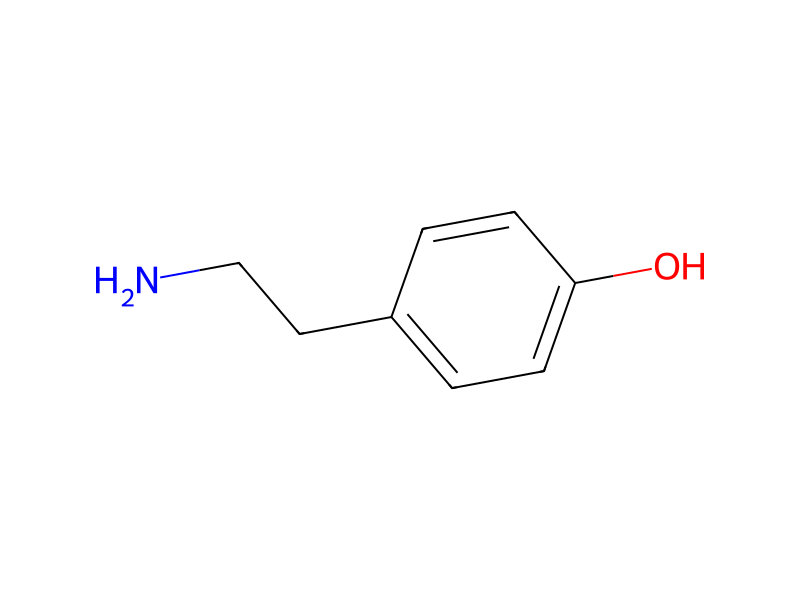
Tyramine → Trifluoroacetate
Reaction equation

[C:1](Cl)(=[O:6])[C:2]([CH3:5])([CH3:4])[CH3:3].[NH2:8][CH2:9][CH2:10][C:11]1[CH:16]=[CH:15][C:14]([OH:17])=[CH:13][CH:12]=1.ClCCl.[F:21][C:22]([F:27])([F:26])[C:23]([OH:25])=[O:24]>>[C:1]([O:17][C:14]1[CH:15]=[CH:16][C:11]([CH2:10][CH2:9][NH2:8])=[CH:12][CH:13]=1)(=[O:6])[C:2]([CH3:5])([CH3:4])[CH3:3].[F:21][C:22]([F:27])([F:26])[C:23]([O-:25])=[O:24]Participants
5



Procedure
A solution of pivaloyl-chloride (10.0 ml) was added dropwise to a stirred solution of tyramine (10.2 g) in a dichloromethane/trifluoroacetic acid mixture (1:1 v/v). The reaction mixture was stirred for 4 hours and the solvents then removed in vacuo. The syrupy residue was triturated with an ethyl acetate/diethyl ether mixture (3:1 v/v) to give 2-(4-pivaloyloxyphenyl)ethylamine as a colourless trifluoroacetate salt, m.p. 255°-257° C.; NMR: 1.3(s, 9H, pivaloyl-H), 2.85(m, 2H, CH2Ph), 3.05(m, 2H, CH2N), 7.05(d, 2H, phenyl-H), 7.3(d, 2H, phenyl-H), 8.0(broad s, 3H, NH3); m/e 222 (M+H)+.
Workup
- customthe solvents then removed in vacuo
- customThe syrupy residue was triturated with an ethyl acetate/diethyl ether mixture (3:1 v/v)
Sources & evidence
- ORD record
- ord-4dc00c3aa68449d09587fa3cc6746cb8
- Source dataset
- uspto-grants-1993_12
- Patent number
- US05270311
Reaction notes
Loading…