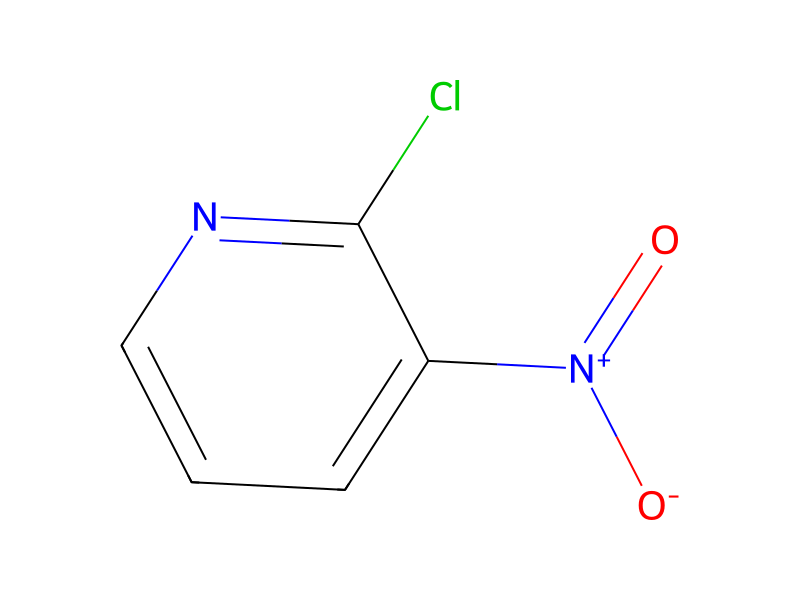
2-Chloro-3-nitropyridine → HCID 131710724, compound
Reaction equation

Cl[C:2]1[C:7]([N+:8]([O-:10])=[O:9])=[CH:6][CH:5]=[CH:4][N:3]=1.[CH2:11]([N:13]([CH2:21][CH3:22])[C:14]1[CH:15]=[C:16]([SH:20])[CH:17]=[CH:18][CH:19]=1)[CH3:12]>>[CH2:21]([N:13]([CH2:11][CH3:12])[C:14]1[CH:15]=[C:16]([CH:17]=[CH:18][CH:19]=1)[S:20][C:2]1[C:7]([N+:8]([O-:10])=[O:9])=[CH:6][CH:5]=[CH:4][N:3]=1)[CH3:22]Participants
3


Procedure
Thus, for example, a compound of the formula ##STR16## is obtained by reaction of 2-chloro-3-nitro-pyridine with 3-diethylaminothiophenol to give 2(3'-diethylaminothiophenoxy)-3-nitro-pyridine, reduction to the 3-amino compound, diazotisation and intramolecular coupling. The oxadiazepine derivative ##STR17## is obtained, for example, by reaction of 3-chloro-4-nitroanisole with 1-diethylamino-3-hydroxynaphthalene to give 1-diethylamino-3-(5'-methoxy-2'-nitro-phenoxy)-naphthalene, reduction to the 2'-amino compound, diazotisation and internal coupling.
Sources & evidence
- ORD record
- ord-28bd3e9a9afd4ac0b865a0015747208e
- Source dataset
- uspto-grants-1977_04
- Patent number
- US04020063
Reaction notes
Loading…