1,3-Butadiene → 1-Nitroanthraquinone
Reaction equation

[N+:1]([C:4]1[CH:13]=[CH:12][CH:11]=[C:10]2[C:5]=1[C:6](=[O:15])[CH:7]=[CH:8][C:9]2=[O:14])([O-:3])=[O:2].[CH2:16]=[CH:17][CH:18]=[CH2:19]>C1(C)C=CC=CC=1>[N+:1]([C:4]1[C:5]2[C:6](=[O:15])[C:7]3[C:8](=[CH:16][CH:17]=[CH:18][CH:19]=3)[C:9](=[O:14])[C:10]=2[CH:11]=[CH:12][CH:13]=1)([O-:3])=[O:2]Participants
Reactant 2


Product 1

Reagents, catalysts & solvents 1
Conditions
- Temperature
- 80 °C
Procedure
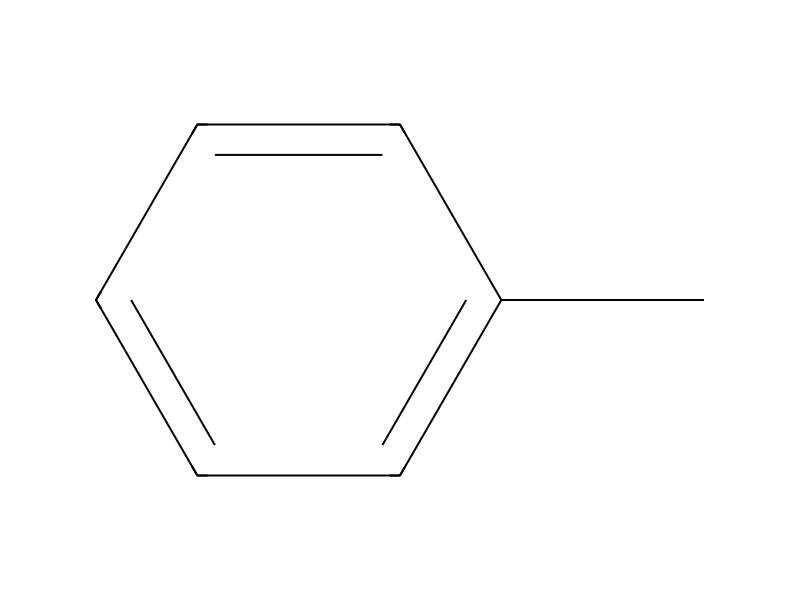
A 1 liter glass pressure reactor is charged with 600 parts of toluene and 122 parts of technical 5-nitro-1,4-naphthoquinone (100%) as ca. 93% product. The reactor is blanketed with nitrogen and 57.6 parts of butadiene are introduced under pressure. The mixture is then heated in the closed system to 80° C. and stirred for 4 hours at this temperature. The pressure falls from a maximum of 3.5 to 4 bar to ca. 3 bar at the conclusion of the reaction. The mixture is cooled, the pressure in the reactor removed over a cooling trap, and excess butadiene is distilled at 400 mbar from the autoclave into the cooling trap. At a distillation temperature of 80° C., a total amount of 336 parts of butadiene/toluene is present in the cooling trap, with a butadiene content of ca. 6%. Then the residual toluene is removed with steam, such that at the conclusion of the steam distillation the suspension of 1-nitro-5,8,11,12-tetrahydroanthraquinone in 750 parts of water is free from toluene. The suspension is then run at 10° C. into a mixture of 160 parts of 50% aqueous sodium hydroxide and 50% aqueous potassium hydroxide. Further processing as described in Example 11 gives 138 parts of pure (99%) 1-nitroanthraquinone, i.e. 90% of theory, based on 5-nitro-1,4-naphthoquinone.
Workup
- additionare introduced under pressure
- customThe pressure falls from a maximum of 3.5 to 4 bar to ca. 3 bar at the conclusion of the reaction
- temperatureThe mixture is cooled
- customthe pressure in the reactor removed over a cooling trap
- distillationexcess butadiene is distilled at 400 mbar from the autoclave into the cooling trap
- customAt a distillation temperature of 80° C.
- customThen the residual toluene is removed with steam, such that at the conclusion of the steam distillation
- additionthe suspension of 1-nitro-5,8,11,12-tetrahydroanthraquinone in 750 parts of water
- additionThe suspension is then run at 10° C. into a mixture of 160 parts of 50% aqueous sodium hydroxide and 50% aqueous potassium hydroxide
Sources & evidence
- ORD record
- ord-d19d7276d80640a097bc6041bfb8e4c6
- Source dataset
- uspto-grants-1990_01
- Patent number
- US04892686
Reaction notes
Loading…