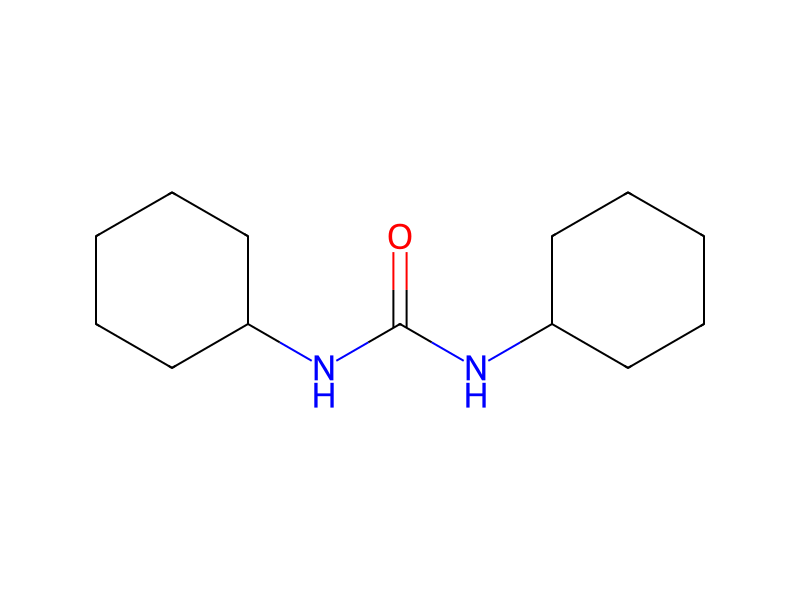
4-Nitrophenol → N,N'-Dicyclohexylurea
Reaction equation

C1C([N+]([O-])=[O:8])=CC=C(O)C=1.CC(CC(CCC(O)=O)=O)=O.N1CCC[C@H]1C(O)=O.[CH:30]1([N:36]=[C:37]=[N:38][CH:39]2[CH2:44][CH2:43][CH2:42][CH2:41][CH2:40]2)[CH2:35][CH2:34][CH2:33][CH2:32][CH2:31]1>C(Cl)(Cl)Cl>[C:37]([NH:36][CH:30]1[CH2:31][CH2:32][CH2:33][CH2:34][CH2:35]1)([NH:38][CH:39]1[CH2:44][CH2:43][CH2:42][CH2:41][CH2:40]1)=[O:8]Participants
Reactant 3



Product 1
Reagents, catalysts & solvents 1

Procedure
Succinylacetonyl-proline was converted to succinylacetonyl-proline-NH-PEG by adding succinylacetonyl-proline to a condensing agent in the presence of p-nitrophenol in chloroform. The reaction was carried out in 10 ml of chloroform by adding 0.55 g (4.0 mmole) of p-nitrophenol to 0.64 g (3.9 mmole) of succinylacetone-proline. Next, 0.80 g (3.3 mmole) of the condensing agent, dicyclohexylcarbodiimide was added. The latter was dissolved in 2 ml chloroform, and added slowly to the mixture with stirring. Within 10 minutes, a white precipitate of dicyclohexylurea formed, and a spectrophotometric determination [L. Aldwin and D. E. Nitecki, 1987, Anal. Biochem., 164:494-501] of the amount of ester present at that time indicated that there was approximately 61.5% ester present. A similar determination two hours later revealed no change in the amount of ester formed. Dicyclohexylurea was removed by filtering the solution, followed by the addition of 0.45 g (1.1 mmole) PEG-4000-NH2 to the filtrate. The reaction mixture was allowed to stir at room temperature overnight. The product, succinylacetonyl-proline-NH-PEG was purified as follows.
Workup
- additionadded slowly to the mixture
Sources & evidence
- ORD record
- ord-865e72382b014d50a110ca272d81b7ba
- Source dataset
- uspto-grants-1990_01
- Patent number
- US04895872
Reaction notes
Loading…