Morpholine → {6-[3-(5-Chloro-pyridin-2-yl)-5-methyl-isoxazol-4-ylmethoxy]-pyridin-3-yl}-morpholin-4-yl-methanone
Reaction equation
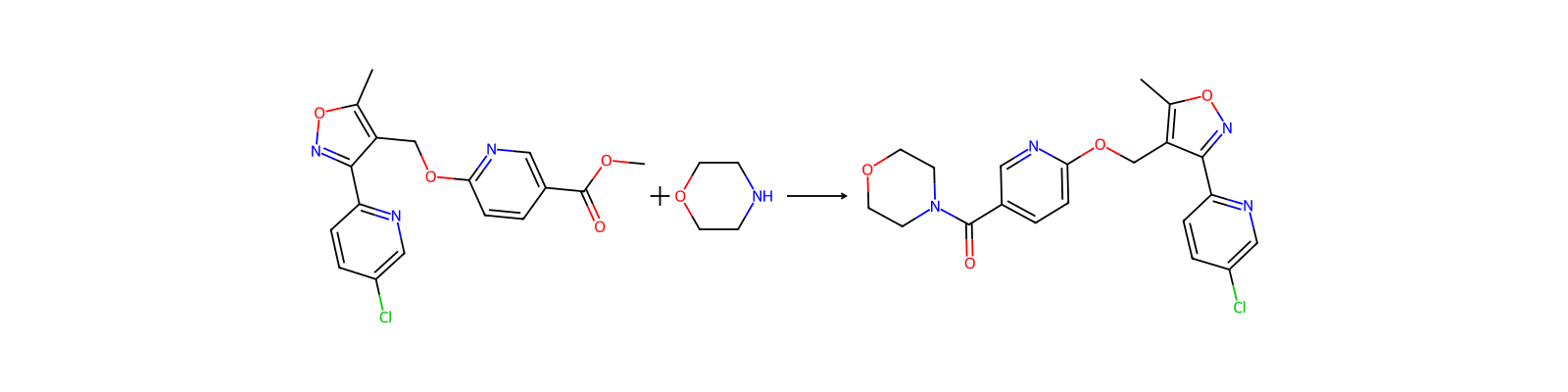
CO[C:3](=[O:25])[C:4]1[CH:9]=[CH:8][C:7]([O:10][CH2:11][C:12]2[C:13]([C:18]3[CH:23]=[CH:22][C:21]([Cl:24])=[CH:20][N:19]=3)=[N:14][O:15][C:16]=2[CH3:17])=[N:6][CH:5]=1.[NH:26]1[CH2:31][CH2:30][O:29][CH2:28][CH2:27]1>>[Cl:24][C:21]1[CH:22]=[CH:23][C:18]([C:13]2[C:12]([CH2:11][O:10][C:7]3[N:6]=[CH:5][C:4]([C:3]([N:26]4[CH2:31][CH2:30][O:29][CH2:28][CH2:27]4)=[O:25])=[CH:9][CH:8]=3)=[C:16]([CH3:17])[O:15][N:14]=2)=[N:19][CH:20]=1Participants
3



Procedure
As described for example 301, [6-[3-(5-chloro-pyridin-2-yl)-5-methyl-isoxazol-4-ylmethoxy]-nicotinic acid methyl ester (108 mg, 0.3 mmol) was converted, using morpholine instead of 4-aminotetrahydropyran to the title compound (18 mg, 15%) which was obtained as a white solid. MS: m/e=415.1 [M+H]+.
Sources & evidence
- ORD record
- ord-75b6ebb349f642e5bf89e75e4d7fca1a
- Source dataset
- uspto-grants-2014_11
- Patent number
- US08877782B2
Reaction notes
Loading…