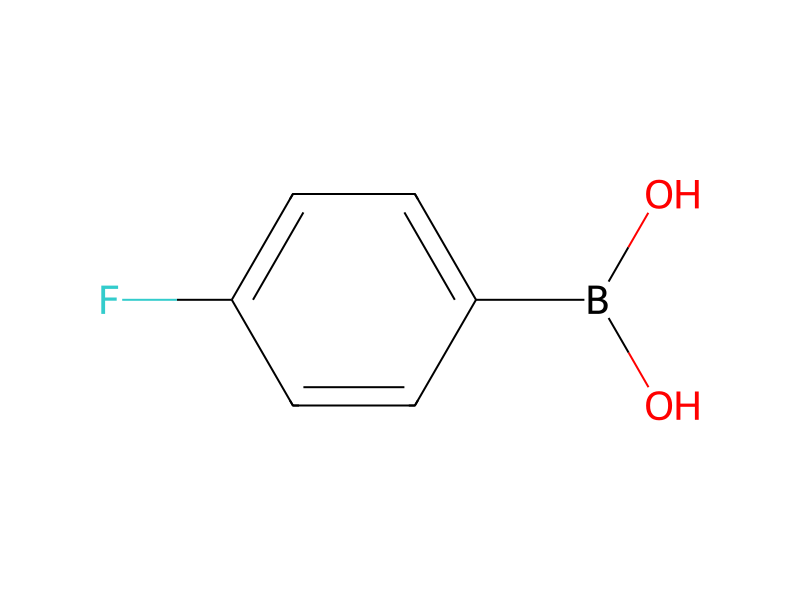
4-Fluorophenylboronic acid → 2-(4-fluorophenyl)-3,4,5,6-tetrahydro-1H-azepino[5,4,3-cd]indol-6-one
Reaction equation

[C:1]1([C:7]2[NH:8][C:9]3[CH:10]=[CH:11][CH:12]=[C:13]4[C:19](=[O:20])[NH:18][CH2:17][CH2:16][C:15]=2[C:14]=34)[CH:6]=[CH:5][CH:4]=[CH:3][CH:2]=1.[F:21]C1C=CC(B(O)O)=CC=1>>[F:21][C:4]1[CH:3]=[CH:2][C:1]([C:7]2[NH:8][C:9]3[CH:10]=[CH:11][CH:12]=[C:13]4[C:19](=[O:20])[NH:18][CH2:17][CH2:16][C:15]=2[C:14]=34)=[CH:6][CH:5]=1Participants
3


Procedure
In a manner similar to that described for Compound 12, the tricyclic bromide (100 mg, 0.54 mmol) and 4-fluorobenzeneboronic acid (79 mg, 0.57 mmol) were coupled to yield 2-(4-fluorophenyl)-3,4,5,6-tetrahydro-1H-azepino[5,4,3-cd]indol-6-one, 107 mg (99%), as a pale-yellow solid. 1H NMR (300 MHz, d6-DMSO) δ 3.04 (m, 2H), 3.38 (m, 2H), 7.22 (app t, 1H, J=7.7 Hz), 7.39 (m, 2H), 7.56 (dd, 1H, J=8.0, 0.9 Hz), 7.64 (m, 3H), 8.05 (br t, 1H), 11.57 (br s, 1H); HRMS (FAB, MH+) Calcd for C17H14FN2O: 281.1090, Found: 281.1093; Anal. (C17H13FN2O.0.6 H2O) C, H, N.
Sources & evidence
- ORD record
- ord-25a2014e0e6a4d60ade1373020ef3781
- Source dataset
- uspto-grants-2008_09
- Patent number
- US07429578B2
Reaction notes
Loading…