Benzyl Bromide → 4-Benzyloxy-3,5-dimethylbenzonitrile
Reaction equation

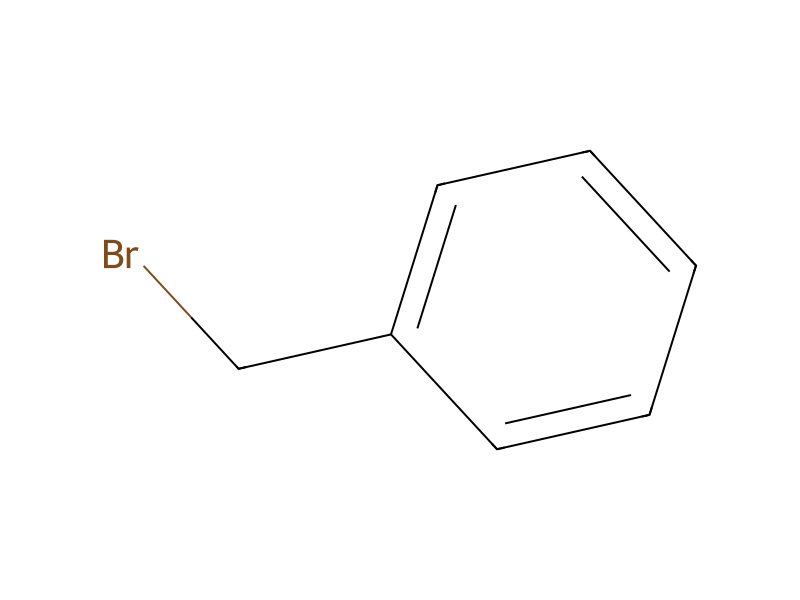
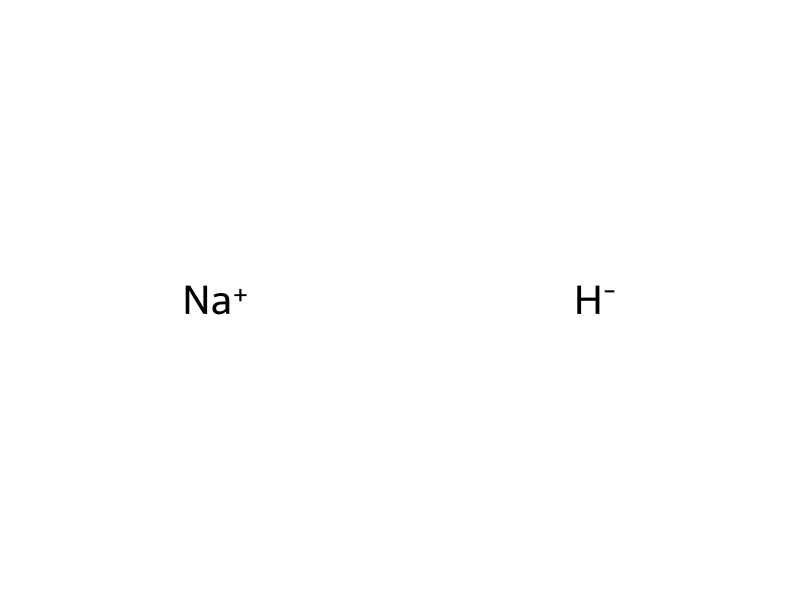
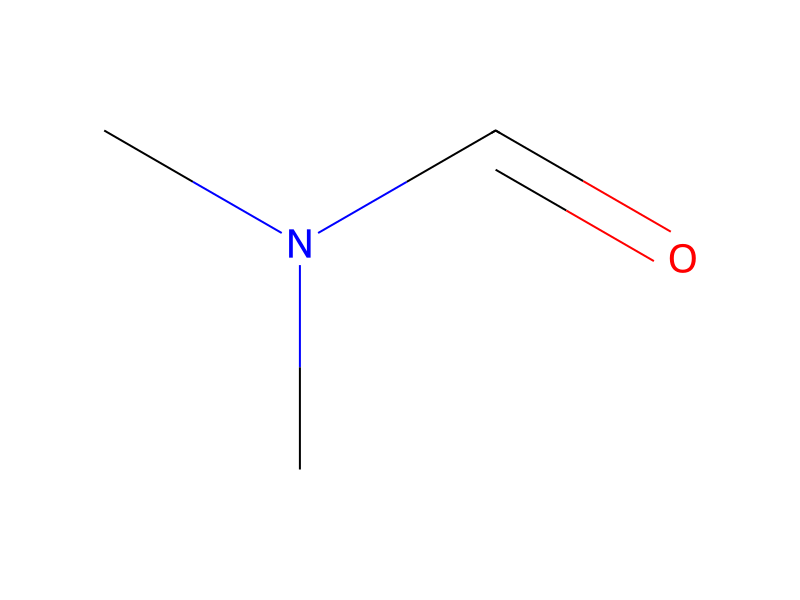
[OH:1][C:2]1[C:9]([CH3:10])=[CH:8][C:5]([C:6]#[N:7])=[CH:4][C:3]=1[CH3:11].[H-].[Na+].[CH2:14](Br)[C:15]1[CH:20]=[CH:19][CH:18]=[CH:17][CH:16]=1>CN(C=O)C>[CH2:14]([O:1][C:2]1[C:3]([CH3:11])=[CH:4][C:5]([C:6]#[N:7])=[CH:8][C:9]=1[CH3:10])[C:15]1[CH:20]=[CH:19][CH:18]=[CH:17][CH:16]=1Participants
Reactant 3

Product 1

Reagents, catalysts & solvents 1
Procedure
A solution of 4,6-dihydroxy-2-methyl nicotinic acid ethyl ester (31 g, 157 mmol) in phosphorus oxychloride (60 mL, 629 mmol) was stirred at reflux for 1.5 h. The extra phosphorus oxychloride was removed and the reaction mixture was poured into ice water. The solid was removed by filtration. The filtrate was extracted with dichloromethane (3×100 mL) and concentrated. The residue was further purified by column chromatography to yield 4,6-dichloro-2-methyl nicotinic acid ethyl ester (16.9 g, 46%). A solution the ester (16.9 g, 71.3 mmol), in MeOH (60 mL) was mixed with sodium methoxide (58 mL, 257 mmol) and stirred at reflux for 12 h. The reaction was quenched by adding AcOH (50 mL), diluted with water (200 mL), extracted with dichloromethane (3×100 mL), and concentrated. The residue was purified by column chromatography to yield 4,6-dimethoxy-2-methyl nicotinic acid methyl ester (10 g, 67%). A solution of the ester (2.6 g, 12.3 mmol), lithium hydroxide (1.06 g, 44.1 mmol) in water (40 mL), MeOH (30 mL) and THF (20 mL) was stirred at reflux for 4 h. The reaction mixture was concentrated to dryness. The residue was mixed with HCl (conc., 20 mL) and was concentrated to dryness to yield crude 4,6-dimethoxy-2-methyl nicotinic acid (quantitative). To a solution of 4,6-dimethoxy-2-methyl nicotinic acid (2.5 g, 12.0 mmol) in dichloromethane (50 mL) and THF (50 mL) at room temperature was added oxalyl chloride (2.57 mL, 29.4 mmol) and DMF (3 drops). The reaction mixture was stirred at room temperature for 0.5 h, concentrated to afford 4,6-dimethoxy-2-methyl nicotinic acid chloride HCl salt (2.8 g). A solution of 4,6-dimethoxy-2-methyl nicotinic acid chloride HCl salt (8.5 g, 33.73 mmol) in dichloromethane (20 mL) and THF (20 mL) at room temperature was mixed with methylamine in THF (50 mL, 98 mmol) and stirred at 20° C. for 1 h. The reaction mixture was diluted with water (100 mL), extracted with dichloromethane (3×100 mL), and concentrated to yield 4,6-dimethoxy-2,N-dimethyl-nicotinamide (4.2 g, 66%) as a light yellow solid. A solution of 4-hydroxy-3,5-dimethylbenzonitrile (2 g, 13.6 mmol) in DMF (20 mL) at room temperature was mixed with sodium hydride (0.706 g, 17.6 mmol) and stirred for 0.5 h. Benzyl bromide (1.62 mL, 13.59 mmol) was then added and the reaction mixture was stirred at room temperature for 24 h. The reaction was quenched by adding water (200 mL), extracted with EtOAc (3×100 mL), and concentrated. The residue was purified by column chromatography to yield 4-benzyloxy-3,5-dimethylbenzonitrile (3.25 g, 100%), as a white solid. To a solution of 4,6-dimethoxy-2,N-dimethyl-nicotinamide (0.54 g, 2.57 mmol) in THF (50 mL) at −20° C. was added n-BuLi (3.54 mL, 5.67 mmol). The reaction was stirred at −20° C. to 0° C. for 2 h and then was cooled to −78° C. 4-Benzyloxy-3,5-dimethylbenzonitrile (0.49 g, 2.057 mmol) was added, the cooling bath was removed, and the reaction was allowed to warm to room temperature. After 14 h, the reaction was quenched by adding water (100 mL), extracted with dichloromethane (3×100 mL), and concentrated. The residue was purified by column chromatography to yield 7-(4-benzyloxy-3,5-dimethyl-phenyl)-2,4-dimethoxy-6H-[1,6]naphthyridin-5-one (0.32 g, 37%). A solution of 7-(4-benzyloxy-3,5-dimethyl-phenyl)-2,4-dimethoxy-6H-[1,6]naphthyridin-5-one (0.25 g, 0.6 mmol) in dichloromethane (100 mL) was mixed with BBr3 (3 mL, 3 mmol) and stirred at room temperature for 16 h. The reaction was quenched by adding water (20 mL). The resulting solid was collected by filtration, washed with water and DCM, to yield a light yellow solid. This solid was mixed with HCl in ether (10 mL, 10 mmol), stirred for 1 h, and filtered to afford 2-hydroxy-7-(4-hydroxy-3,5-dimethylphenyl)-4-methoxy-1,6-naphthyridin-5(6H)-one hydrochloride (70 mg, 37%) as a light yellow solid. Selected data: MS (ES) m/z: 312; MP>330° C. (hydrochloride).
Workup
- stirringthe reaction mixture was stirred at room temperature for 24 h
- customThe reaction was quenched
- additionby adding water (200 mL)
- extractionextracted with EtOAc (3×100 mL)
- concentrationconcentrated
- customThe residue was purified by column chromatography
Sources & evidence
- ORD record
- ord-f90b09444558466cb5f53e633f70fd56
- Source dataset
- uspto-grants-2014_11
- Patent number
- US08889698B2
Reaction notes
Loading…