Ammonia → Benzylamine
Reaction equation

[CH2:1](O)[C:2]1[CH:7]=[CH:6][CH:5]=[CH:4][CH:3]=1.[NH3:9].[C:10]1([CH3:18])[CH:15]=[C:14](C)[CH:13]=[C:12](C)[CH:11]=1>[Ru]>[CH2:1]([NH2:9])[C:2]1[CH:7]=[CH:6][CH:5]=[CH:4][CH:3]=1.[CH:1](=[N:9][CH2:18][C:10]1[CH:15]=[CH:14][CH:13]=[CH:12][CH:11]=1)[C:2]1[CH:7]=[CH:6][CH:5]=[CH:4][CH:3]=1Participants
Reactant 3


Product 2
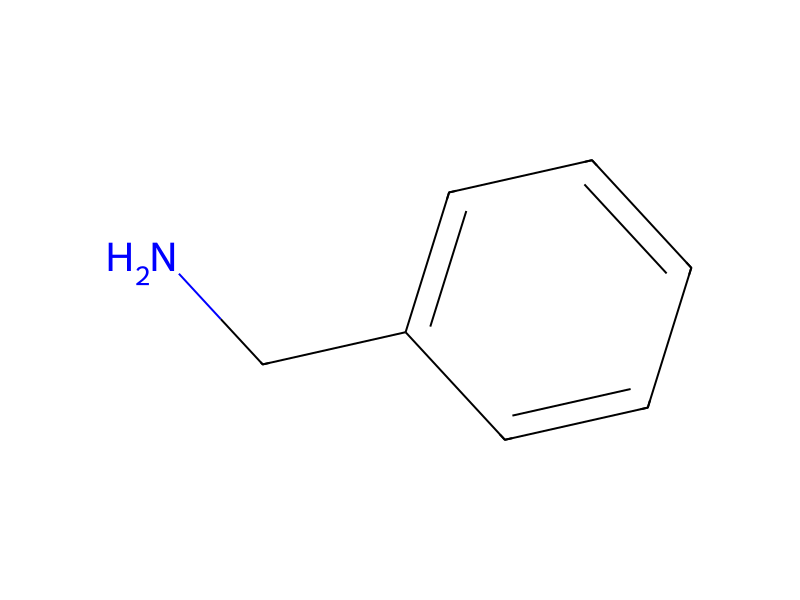

Reagents, catalysts & solvents 1

Procedure
Benzyl alcohol was reacted with ammonia in the presence of ruthenium catalyst 1 (0.1 mol %) in refluxing mesitylene (b.p. 163° C.). As shown in Table 1 entries 1-3, 98% conversion of the alcohol was observed after 1 hr, yielding 69% of benzylamine and 28% of N-benzylidenebenzylamine. Slightly higher yields of benzylamine were observed at longer reaction times. Similar results were obtained at lower temperature in refluxing p-xylene (b.p. 138° C.) after 3 hrs (Table 1, entry 4). When the reaction was performed for the same period in toluene (b.p. 110.5° C.) the conversion of benzyl alcohol was less efficient (Table 1, entry 5), but after 13 h 99% conversion of benzyl alcohol occurred (Table 1, entry 6) to provide benzylamine in 87% yield along with N-benzylidenebenzylamine (12%). A further drop in reaction temperature using dioxane (b.p. 100° C.) as a solvent resulted in a lower conversion (Table 1, entry 7).
Sources & evidence
- ORD record
- ord-9fc1e936f4254bb69cbc6a33097e80ed
- Source dataset
- uspto-grants-2014_11
- Patent number
- US08889865B2
Reaction notes
Loading…