Ammonia → Benzylamine
Reaction equation

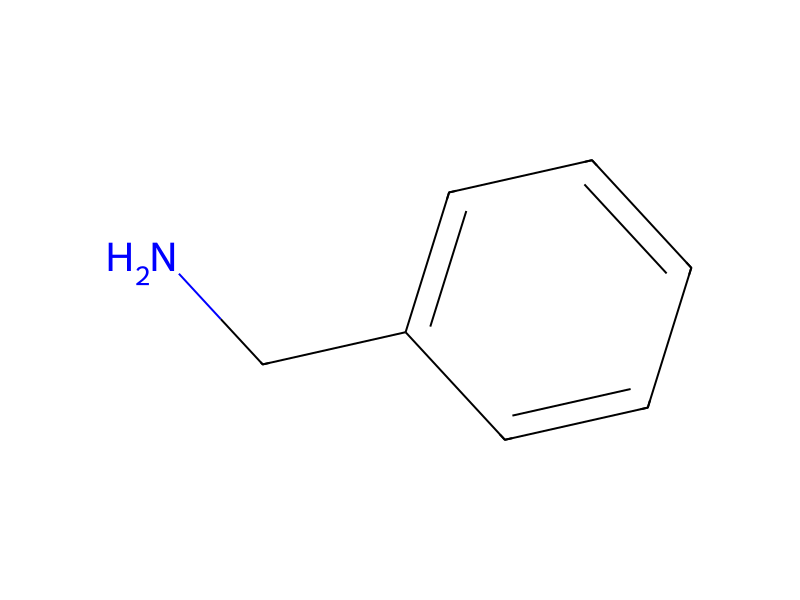
[NH3:1].[CH2:2]([OH:9])[C:3]1[CH:8]=[CH:7][CH:6]=[CH:5][CH:4]=1>C1(C)C=CC=CC=1>[CH2:2]([NH2:1])[C:3]1[CH:8]=[CH:7][CH:6]=[CH:5][CH:4]=1.[CH:2](=[N:1][CH2:2][C:3]1[CH:8]=[CH:7][CH:6]=[CH:5][CH:4]=1)[C:3]1[CH:8]=[CH:7][CH:6]=[CH:5][CH:4]=1.[CH2:2]([OH:9])[C:3]1[CH:8]=[CH:7][CH:6]=[CH:5][CH:4]=1Participants
6
Reactant 2


Product 3

Reagents, catalysts & solvents 1

Procedure
To test whether increasing the concentration of ammonia relative to the alcohol might reduce the formation of imines (for example by capturing the contemplated intermediate aldehyde and preventing its reaction with the primary amine), complex 1 (0.01 mmol), benzyl alcohol (2.5 mmol) and ammonia (8 atm) in toluene were heated under reflux in a Fischer-Porter tube for 130 min, to get benzylamine (64.6%) and N-benzylidenebenzylamine (19.3%) whereas the conversion of benzyl alcohol was 84.7% (compare to entry 6, Table 1). Thus, increasing the concentration of ammonia did not affect the extent of formation of imine.
Workup
- temperaturewere heated
- temperatureunder reflux in a Fischer-Porter tube for 130 min
Sources & evidence
- ORD record
- ord-90461399950e43e49f5694cb1cb97498
- Source dataset
- uspto-grants-2014_11
- Patent number
- US08889865B2
Reaction notes
Loading…