(S)-3-(tert-butyldimethylsilanyloxy)-1-(2-fluorophenyl)propylamine → HCID 178431662, compound
Reaction equation

[Si]([O:8][CH2:9][CH2:10][C@H:11]([NH2:19])[C:12]1[CH:17]=[CH:16][CH:15]=[CH:14][C:13]=1[F:18])(C(C)(C)C)(C)C.[C:20]1([C:39]2[CH:44]=[CH:43][CH:42]=[CH:41][CH:40]=2)[CH:25]=[CH:24][C:23]([CH:26]2[C:31]([CH3:33])([CH3:32])[O:30][C:29](OCC)=[N:28][S:27]2(=[O:38])=[O:37])=[CH:22][CH:21]=1>ClCCl>[C:20]1([C:39]2[CH:40]=[CH:41][CH:42]=[CH:43][CH:44]=2)[CH:25]=[CH:24][C:23]([CH:26]2[C:31]([CH3:32])([CH3:33])[O:30][C:29]([NH:19][C@H:11]([C:12]3[CH:17]=[CH:16][CH:15]=[CH:14][C:13]=3[F:18])[CH2:10][CH2:9][OH:8])=[N:28][S:27]2(=[O:37])=[O:38])=[CH:22][CH:21]=1Participants
Reactant 2


Product 1

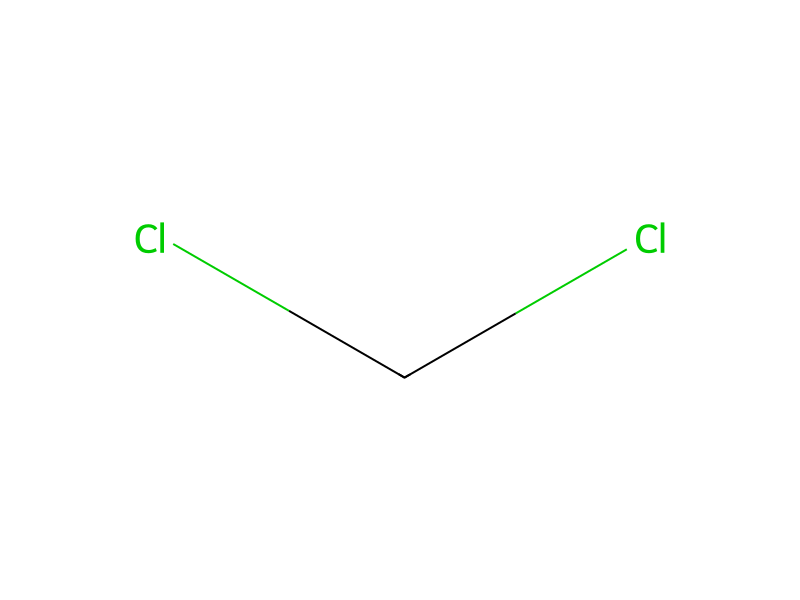
Reagents, catalysts & solvents 1
Procedure
In a round-bottom flask, 346 mg of 5-biphenyl-4-yl-2-ethoxy-6,6-dimethyl-5,6-dihydro-1,4,3-oxathiazine 4,4-dioxide were dissolved under inert gas in 2 ml of dichloromethane and admixed with 328 mg of (S)-3-(tert-butyldimethylsilanyloxy)-1-(2-fluorophenyl)propylamine. After concentration by rotary evaporation, the residue was suspended in 0.5 ml of dichloromethane and stirred at room temperature for 18 hours. The conversion was checked by LCMS. Since reactant was still present, the reaction mixture, after the addition of 1 ml of toluene, was stirred at 50° C. for 1 hour. Even after stirring at 75° C. for a further 4 hours, the conversion remained incomplete. The solvent was removed under reduced pressure. To detach the protecting group, the residue was taken up in 1 ml of methanol and, after addition of 0.05 ml of concentrated hydrochloric acid, stirred at room temperature for 1 hour. After concentration by rotary evaporation, the residue was purified in a purification laboratory by means of preparative HPLC. The product-containing fractions were combined and freed of the solvent under reduced pressure. The aqueous residue was extracted with ethyl acetate, and the combined organic phases were dried using a diatomaceous earth cartridge (Varian Chem Elut®) and concentrated by rotary evaporation. The residue was dissolved in a mixture of acetonitrile and water and lyophilized. This gave the product (221 mg) with a molecular weight of 482.6 g/mol (C26H27FN2O4S); MS (ESI): m/e=483 (M+H+).
Workup
- concentrationAfter concentration
- customby rotary evaporation
- additionthe reaction mixture, after the addition of 1 ml of toluene
- stirringwas stirred at 50° C. for 1 hour
- stirringEven after stirring at 75° C. for a further 4 hours
- customThe solvent was removed under reduced pressure
- additionafter addition of 0.05 ml of concentrated hydrochloric acid
- stirringstirred at room temperature for 1 hour
- concentrationAfter concentration
- customby rotary evaporation
- customthe residue was purified in a purification laboratory by means of preparative HPLC
- extractionThe aqueous residue was extracted with ethyl acetate
- customthe combined organic phases were dried
- concentrationconcentrated by rotary evaporation
- dissolutionThe residue was dissolved in a mixture of acetonitrile and water
Sources & evidence
- ORD record
- ord-ed828bc7b9334673b9c9e69696921922
- Source dataset
- uspto-grants-2014_11
- Patent number
- US08895547B2
Reaction notes
Loading…