4-Methylbenzophenone → 4-(Bromomethyl)benzophenone
Reaction equation

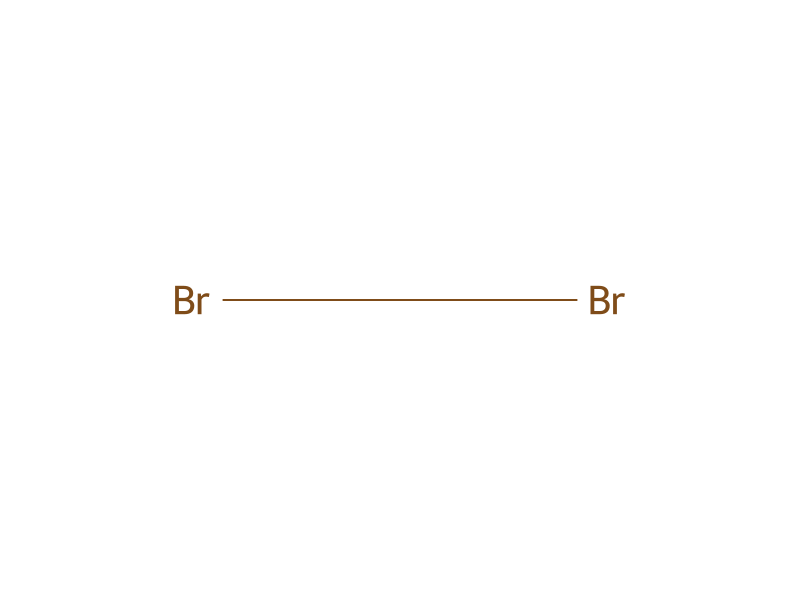
[CH3:1][C:2]1[CH:15]=[CH:14][C:5]([C:6]([C:8]2[CH:13]=[CH:12][CH:11]=[CH:10][CH:9]=2)=[O:7])=[CH:4][CH:3]=1.[Br:16]Br>C1C=CC=CC=1>[Br:16][CH2:1][C:2]1[CH:15]=[CH:14][C:5]([C:6]([C:8]2[CH:13]=[CH:12][CH:11]=[CH:10][CH:9]=2)=[O:7])=[CH:4][CH:3]=1Participants
Reactant 2

Product 1

Reagents, catalysts & solvents 1

Procedure
4-Methylbenzophenone, 750 g (3.82 moles), was added to a 5 liter Morton flask equipped with an overhead stirrer and dissolved in 2850 ml of benzene. The solution was then heated to reflux, followed by the dropwise addition of 610 g (3.82 moles) of bromine in 330 ml of benzene. The addition rate was approximately 1.5 ml/min and the flask was illuminated with a 90 watt (90 joule/sec) halogen spotlight to initiate the reaction . A timer was used with the lamp to provide a 10% duty cycle (on 5 seconds, off 40 seconds), followed in one hour by a 20% duty cycle (on 10 seconds, off 40 seconds). At the end of the addition, the product was analyzed by gas chromatography and was found to contain 71% of the desired Compound VI, 8% of the dibromo product, and 20% unreacted 4-methylbenzophenone. After cooling, the reaction mixture was washed with 10 g of sodium bisulfite in 100 ml of water, followed by washing with 3×200 ml of water. The product was dried over sodium sulfate and recrystallized twice from 1:3 toluene : hexane. After drying under vacuum, 635 g of Compound VI were isolated, providing a yield of 60% and having a melting point of 112°-114° C. Analysis on an NMR spectrometer was consistent with the desired product: 1H NMR (CDCl3) aromatic protons 7.20-7.80 (m, 9 H) and benzylic protons 4.48 (s, 2 H). The final compound was stored for use in the preparation of a photoactivatable chain transfer agent as described in Example 7.
Workup
- customequipped with an overhead stirrer
- temperatureThe solution was then heated
- temperatureto reflux
- customthe reaction
- customto provide a 10% duty cycle (on 5 seconds, off 40 seconds)
- additionAt the end of the addition
- temperatureAfter cooling
- washthe reaction mixture was washed with 10 g of sodium bisulfite in 100 ml of water
- washby washing with 3×200 ml of water
- dry with materialThe product was dried over sodium sulfate
- customrecrystallized twice from 1:3 toluene
- customAfter drying under vacuum
Sources & evidence
- ORD record
- ord-e654ab9206c647e1989d502f0fecb3ea
- Source dataset
- uspto-grants-1999_01
- Patent number
- US05858653
Reaction notes
Loading…