HuagongsheHuagongshe Chemistry Print Report · For research reference only
HRID 34529Generated: October 25, 2026
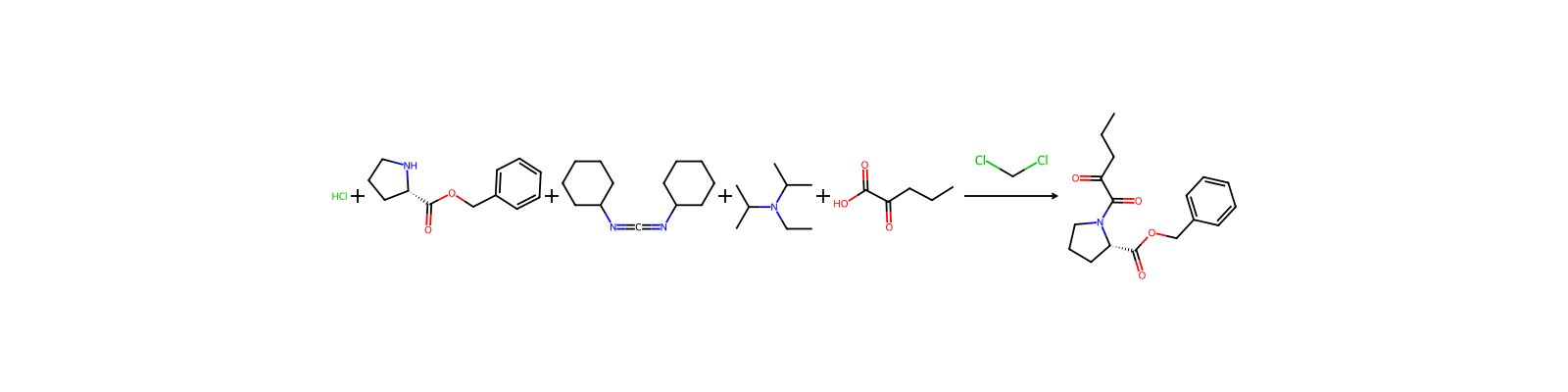
Dicyclohexylcarbodiimide → Benzyl N-(2-oxopentanoyl)prolinate
https://huagongshe.com/reaction/34529
Participants
| Role | Name | HCID | Charge |
|---|
| Reactant | Dicyclohexylcarbodiimide | HCID 10868 | — |
| Reactant | 2-Oxovaleric acid | HCID 74563 | — |
| Reactant | Diisopropylethylamine | HCID 81531 | — |
| Reactant | Proline benzyl ester hydrochloride | HCID 2733413 | — |
| Solvent | Dichloromethane | HCID 6344 | — |
| Product | Benzyl N-(2-oxopentanoyl)prolinate | HCID 53809756 | — |
Reaction Steps
8.8 g benzyl prolinate hydrochloride, 9.78 g dicyclohexylcarbodiimide and 6.12 g diisopropylethylamine were reacted together in 50 mL dichloromethane at 0°. 5.51 g 2-oxopentanoic acid in 10 mL dichloromethane was added dropwise at 0°. The pH of the reaction was adjusted to between 8 and 9 with diisopropylethylamine. The reaction mixture was stirred for four hours at 0°, then room temperature overnight. The next day, the reaction mixture was filtered, concentrated to dryness, and partitioned between ethyl acetate and water. The organic layer was washed with 5% sodium bisulfate, 5% sodium bicarbonate, and saturated sodium chloride solutions, and dried with magnesium sulfate. The organic layer was concentrated to give a yellow oil. The oil was then passed through a silica gel column and eluted with ethyl acetate/hexane (4:6) and ethyl acetate/hexane (1:1). Benzyl N-(2-oxopentanoyl)prolinate, [α]D25 -56.9, was isolated.
Provenance & Evidence
| DOI | 10.6084/m9.figshare.5104873.v1 |
|---|
| Patent number | US04762821 |
|---|
| Source dataset | uspto-grants-1988_08 |
|---|
| ORD ID | ord-1518e2ac8a1d43678cc8596fcb89ca73 |
|---|
| Source note | uspto-grants-1988_08 |
|---|