Diisopropylethylamine → N-(4-(1H-Pyrrolo[2,3-b]pyridin-4-yloxy)-3-fluorophenyl)-1-(4-fluorobenzyl)-2-oxo-1,2-dihydropyridine-3-carboxamide, hydrochloride salt
Reaction equation

[F:1][C:2]1[CH:18]=[CH:17][C:5]([CH2:6][N:7]2[CH:12]=[CH:11][CH:10]=[C:9]([C:13]([OH:15])=O)[C:8]2=[O:16])=[CH:4][CH:3]=1.[ClH:19].Cl.[F:21][C:22]1[CH:23]=[C:24]([NH:49]C(NC(=O)CC2C=CC(F)=CC=2)=S)[CH:25]=[CH:26][C:27]=1[O:28][C:29]1[C:34]2=[C:35]([CH3:48])C(OCCN3CCN(C)CC3)=CN2N=CN=1.C[N:64]([C:66](ON1N=NC2C=CC=CC1=2)=[N+:67]([CH3:69])C)C.[B-](F)(F)(F)F.[CH3:85]CN(C(C)C)C(C)C>CN(C=O)C>[ClH:19].[NH:64]1[C:66]2=[N:67][CH:69]=[CH:85][C:29]([O:28][C:27]3[CH:26]=[CH:25][C:24]([NH:49][C:13]([C:9]4[C:8](=[O:16])[N:7]([CH2:6][C:5]5[CH:4]=[CH:3][C:2]([F:1])=[CH:18][CH:17]=5)[CH:12]=[CH:11][CH:10]=4)=[O:15])=[CH:23][C:22]=3[F:21])=[C:34]2[CH:35]=[CH:48]1Participants
Reactant 4
 HCID 81531Diisopropylethylamine
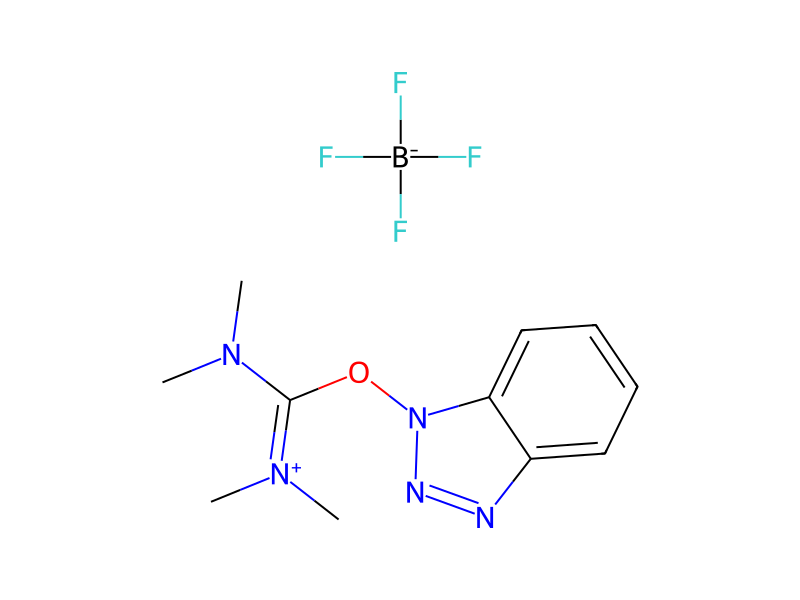 HCID 2733207O-(Benzotriazol-1-yl)-N,N,N',N'-tetramethyluronium tetrafluoroborate
 HCID 168966831-(4-Fluoro-benzyl)-2-oxo-1,2-dihydro-pyridine-3-carboxylic acid
 HCID 1317262361-(3-Fluoro-4-(5-methyl-6-(2-(4-methylpiperazin-1-yl)ethoxy)pyrrolo[2,1-f][1,2,4] triazin-4-yloxy)phenyl)-3-(2-(4-fluorophenyl)acetyl)thiourea, bis-hydrochloride salt2×
Product 1

Reagents, catalysts & solvents 1

Conditions
- Temperature
- 0 °C
Procedure
A homogeneous solution of 1-(4-fluorobenzyl)-2-oxo-1,2-dihydropyridine-3-carboxylic acid (0.051 g, 0.21 mmol, 1.0 eq), 4-(1H-pyrrolo[2,3-b]pyridin-4-yloxy)-3-fluorobenzenamine (0.50 g, 0.21 mmol, 1.0 eq, Compound B of Example 132) and TBTU (0.086 g, 0.23 mmol, 1.1 eq) in DMF (1 mL) was treated with DIPEA (0.11 mL, 0.62 mmol, 3.0 eq) at room temperature. The reaction mixture was stirred for 12 h and quenched with 10% aqueous LiCl (15 mL). The resulting solution was extracted with ethyl acetate (4×40 mL). The combined organic extracts were washed with 10% aqueous LiCl (4×50 mL), dried (Na2SO4), filtered and the filtrate concentrated in vacuo. The residue was purified by flash chromatography (SiO2, eluting 0–2.5% MeOH in CHCl3) and the appropriate fractions were isolated and concentrated in vacuo. The free base was dissolved in THF, cooled to 0° C. and the homogeneous solution treated with anhydrous 4 N HCl in dioxane. The reaction mixture was warmed to room temperature, concentrated in vacuo and the residue triturated with diethyl ether. The solid was dried in vacuo to afford the title compound (0.062 g, 59%) as a HCl salt. 1H NMR (DMSO-d6) δ 12.43 (s, 1H), 12.27 (s, 1H), 8.50–8.52 (m, 1H), 8.35–8.37 (m, 1H), 8.25–8.27 (m, 1H), 8.05–8.0 (m, 1H), 7.43–7.55 (m, 5H), 7.20–7.24 (m, 2H), 6.71 (t, 1H, J=6.89 Hz), 6.65 (d, 1H, J=6.03 Hz), 6.43 (s, 1H), 5.32 (s, 2H); HRMS(ESI+): calcd: 473.1425, found: 473.1427.
Workup
- customquenched with 10% aqueous LiCl (15 mL)
- extractionThe resulting solution was extracted with ethyl acetate (4×40 mL)
- washThe combined organic extracts were washed with 10% aqueous LiCl (4×50 mL)
- dry with materialdried (Na2SO4)
- filtrationfiltered
- concentrationthe filtrate concentrated in vacuo
- customThe residue was purified by flash chromatography (SiO2, eluting 0–2.5% MeOH in CHCl3)
- customthe appropriate fractions were isolated
- concentrationconcentrated in vacuo
- dissolutionThe free base was dissolved in THF
- additionthe homogeneous solution treated with anhydrous 4 N HCl in dioxane
- temperatureThe reaction mixture was warmed to room temperature
- concentrationconcentrated in vacuo
- customthe residue triturated with diethyl ether
- customThe solid was dried in vacuo
Sources & evidence
- ORD record
- ord-f6ef18a356fa4c91a3ace8563263be83
- Source dataset
- uspto-grants-2007_02
- Patent number
- US07173031B2
Reaction notes
Loading…