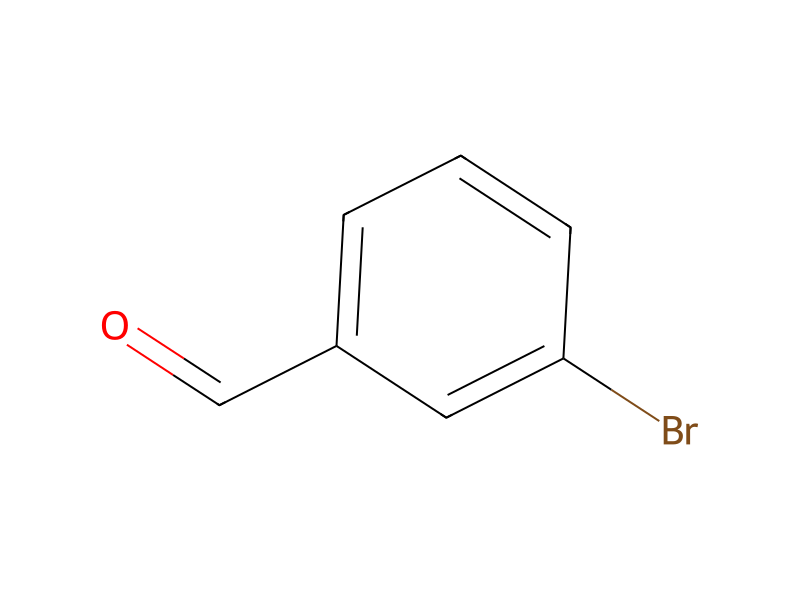
3-Bromobenzaldehyde → 2-(3-Bromophenyl)-4,5-dimethyloxazole-3-oxide
Reaction equation

[CH3:1][C:2](=[N:6][OH:7])[C:3](=[O:5])[CH3:4].[Br:8][C:9]1[CH:10]=[C:11]([CH:14]=[CH:15][CH:16]=1)[CH:12]=O>C(O)(=O)C>[Br:8][C:9]1[CH:10]=[C:11]([C:12]2[O:5][C:3]([CH3:4])=[C:2]([CH3:1])[N+:6]=2[O-:7])[CH:14]=[CH:15][CH:16]=1Participants
Reactant 2

Product 1

Reagents, catalysts & solvents 1

Procedure
A solution of 2,3-butanedione monooxime (50 g, 0.49 mol) and 3-bromobenzaldehyde (101 g, 0.54 mol) in acetic acid (500 mL) was cooled to 0° C. and then gaseous HCl was bubbled through the solution for 35 min while the reaction was stirred in an ice bath. Diethyl ether (500 mL) was then added to the reaction to precipitate the product and the resultant slurry stirred 45 min at 0° C. before being filtered. The solids were rinsed with Et2O (50 mL), taken up in water (1 L) and concentrated NH4OH (60 mL) added to the slurry. This mixture was extracted with CHCl3, the organic layer was dried (MgSO4), and the solvent removed in vacuo to give 97.4 g (74%) of 2-(3-bromophenyl)-4,5-dimethyloxazole-3-oxide as a white solid. The compound should be used directly with 24–48 h.
Workup
- customgaseous HCl was bubbled through the solution for 35 min while the reaction
- additionDiethyl ether (500 mL) was then added to the reaction
- customto precipitate the product
- stirringthe resultant slurry stirred 45 min at 0° C.
- filtrationbefore being filtered
- washThe solids were rinsed with Et2O (50 mL)
- additionconcentrated NH4OH (60 mL) added to the slurry
- extractionThis mixture was extracted with CHCl3
- dry with materialthe organic layer was dried (MgSO4)
- customthe solvent removed in vacuo
Sources & evidence
- ORD record
- ord-ee737189a9ad4ff5980d99110575a1c3
- Source dataset
- uspto-grants-2007_02
- Patent number
- US07176224B2
Reaction notes
Loading…