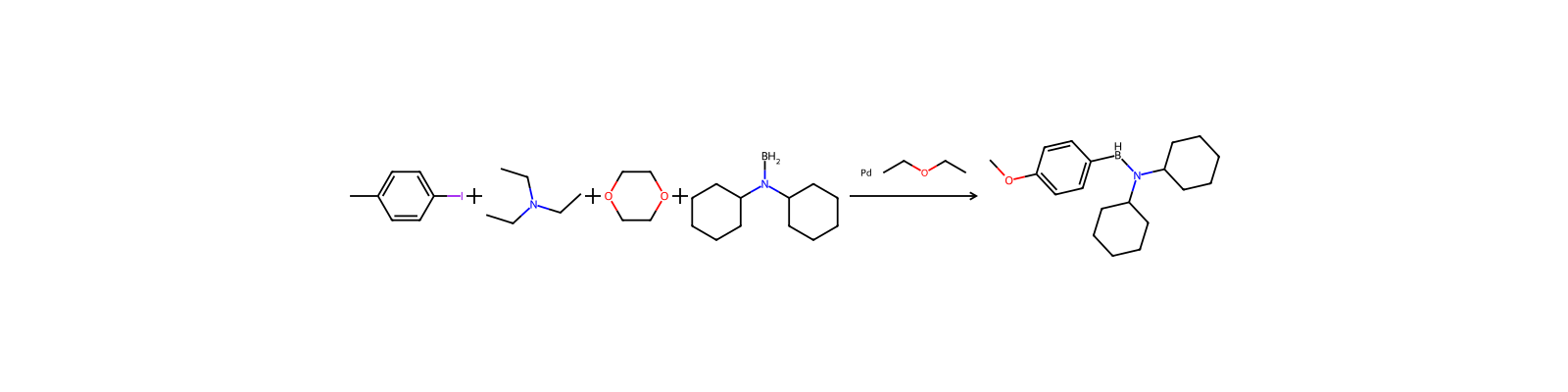
Participants
| Role | Name | HCID | Charge |
|---|
| Reactant | Triethylamine | HCID 8471 | — |
| Reactant | 4-Iodotoluene | HCID 12207 | — |
| Reactant | 1,4-Dioxane | HCID 31275 | — |
| Reactant | HCID 101758441 | HCID 101758441 | — |
| Catalyst | Palladium | HCID 23938 | — |
| Solvent | Diethyl Ether | HCID 3283 | — |
| Product | HCID 58805509 | HCID 58805509 | — |
Reaction Steps
1.130 g (0.19 mmol) of palladium catalyst (Ph3P)2PdCl2, 0.868 g (3.7 mmol) of p-iodotoluene, 2.5 ml (18.5 mmol) of triethylamine, 15 ml of dioxane and 0.708 g (3.7 mmol) of dicyclohexylaminoborane were introduced into a 100 ml Schlenk vessel dried beforehand under argon. The Schlenk vessel was subsequently equipped with a reflux condenser connected via the top to a bubbler. The reaction mixture was stirred magnetically and heated at 70° C. for 15 h. The reaction mixture was subsequently allowed to return, under argon, to ambient temperature. The solvent and the excess reactants were evaporated under the vacuum of a vane pump. The residue obtained was taken up in anhydrous ether and then filtered under argon through dry Celite® 545. The filtrate was again evaporated and the residue was distilled in a Kügelrohr distillation apparatus (T=40° C.) under a vacuum of 0.01 mmHg. 0.884 g (Yd=81%) of a white solid was isolated. The spectroscopic characteristics are as follows:
Provenance & Evidence
| DOI | 10.6084/m9.figshare.5104873.v1 |
|---|
| Patent number | US07179940B2 |
|---|
| Source dataset | uspto-grants-2007_02 |
|---|
| ORD ID | ord-787190f847004fcb9b2c2eca9f3b86b0 |
|---|
| Source note | uspto-grants-2007_02 |
|---|