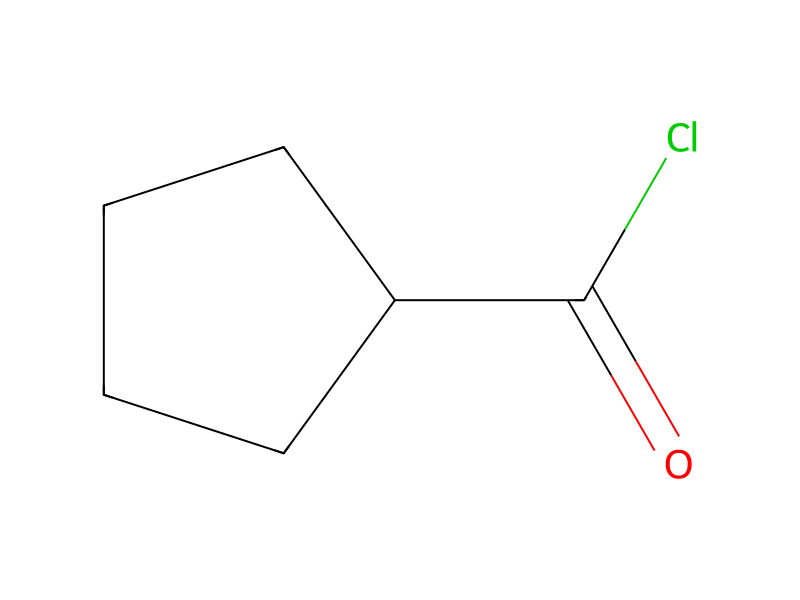
Cyclopentanecarbonyl chloride → HCID 9924376, compound
Reaction equation

[C:1]([NH:4][C:5]1[CH:6]=[C:7]2[C:12](=[CH:13][CH:14]=1)[N:11]=[C:10]([NH:15][NH2:16])[N:9]([CH2:17][C:18]1[CH:23]=[CH:22][CH:21]=[CH:20][CH:19]=1)[C:8]2=[O:24])(=[O:3])[CH3:2].[CH:25]1(C(Cl)=O)CCC[CH2:26]1>C(O)(=O)C>[C:1]([NH:4][C:5]1[CH:6]=[C:7]2[C:12](=[CH:13][CH:14]=1)[N:11]1[C:25]([CH3:26])=[N:16][N:15]=[C:10]1[N:9]([CH2:17][C:18]1[CH:19]=[CH:20][CH:21]=[CH:22][CH:23]=1)[C:8]2=[O:24])(=[O:3])[CH3:2]Participants
4
Reactant 2

Product 1

Reagents, catalysts & solvents 1

Procedure
7.0 g (21.6 mmol) of 6-acetamido-3-benzyl-2-hydrazino-3,4-dihydro-quinazolin-4-one (synthesized according to a process described in patent application WO 00/66584) dissolved in glacial acetic acid are placed in a round-bottomed flask equipped with a stirrer and a condenser. Then, 3.15 g (23.8 mmol) of cyclopentylformyl chloride are added in a portionwise manner with stirring. The solution obtained is heated to reflux for 20 min. The solvent is evaporated off under vacuum and the residue is taken up in water.
Workup
- customare placed in a round-bottomed flask
- customequipped with a stirrer and a condenser
- customThe solution obtained
- temperatureis heated
- temperatureto reflux for 20 min
- customThe solvent is evaporated off under vacuum
Sources & evidence
- ORD record
- ord-28cf0abf615842e4b3df6f2e2642da1f
- Source dataset
- uspto-grants-2004_06
- Patent number
- US06747035B2
Reaction notes
Loading…