Lysine Monohydrate → L-Lysine
Reaction equation

O.[NH2:2][C@H:3]([C:9]([OH:11])=[O:10])[CH2:4][CH2:5][CH2:6][CH2:7][NH2:8].[PH2]([O-])=O.[Na+]>>[NH2:2][C@H:3]([C:9]([OH:11])=[O:10])[CH2:4][CH2:5][CH2:6][CH2:7][NH2:8]Participants


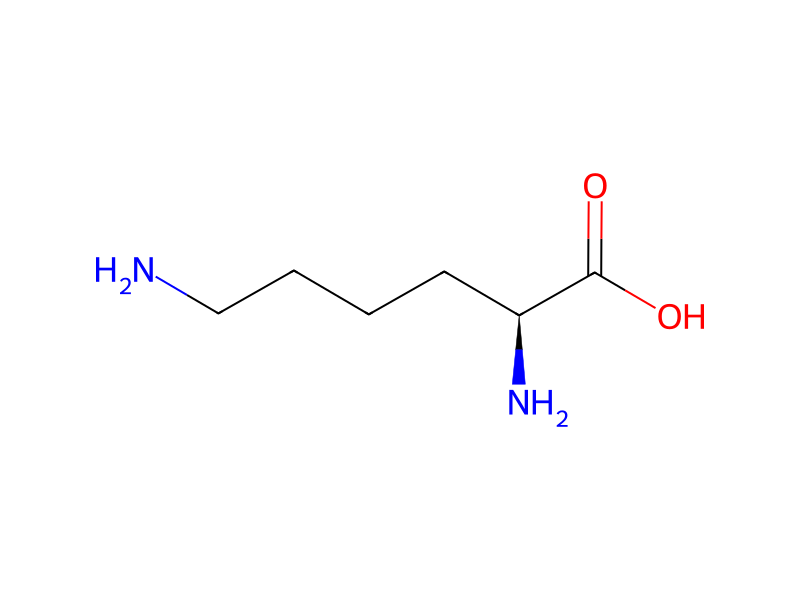
Conditions
- Temperature
- 200 °C
Procedure
L-lysine monohydrate (821 g, 5.0 mol) and sodium hypophosphite (0.1 g) are placed in a pressurizable 2.5 l reaction vessel and blanketed with nitrogen. The reaction vessel is then sealed and the contents heated at 200° C. for 6 h, during which time the internal pressure rose to 11.2 bar. The pressure is then slowly released to remove water from the reaction mixture. The reaction temperature is maintained at 200° C. for 0.5 h to remove residual amounts of solvent and volatile products. The reaction mixture is then stirred at 200° C. for 25 minutes at 20 mbar of pressure, after which the viscous melt is cooled to 115° C., removed from the reaction vessel and subsequently cooled to ambient temperature. The resulting lysine homo-condensate has a Mw of 4300 daltons.
Workup
- customThe reaction vessel is then sealed
- customto remove water from the reaction mixture
- temperatureThe reaction temperature is maintained at 200° C. for 0.5 h
- customto remove residual amounts of solvent and volatile products
- temperatureafter which the viscous melt is cooled to 115° C.
- customremoved from the reaction vessel
- temperaturesubsequently cooled to ambient temperature
Sources & evidence
- ORD record
- ord-38869f472a644c3cb507d44bc1b4b94b
- Source dataset
- uspto-grants-2004_06
- Patent number
- US06750189B1
Reaction notes
Loading…