Formaldehyde → 1,3-Dioxan-5-yl 3-pyridyl ketone
Reaction equation

[C:1]([C:4]1[CH:5]=[N:6][CH:7]=[CH:8][CH:9]=1)(=[O:3])[CH3:2].[CH2:10]=[O:11].B(F)(F)F.C[CH2:17][O:18][CH2:19]C>C(O)(=O)C>[N:6]1[CH:7]=[CH:8][CH:9]=[C:4]([C:1]([CH:2]2[CH2:10][O:11][CH2:19][O:18][CH2:17]2)=[O:3])[CH:5]=1Participants
5
Reactant 3

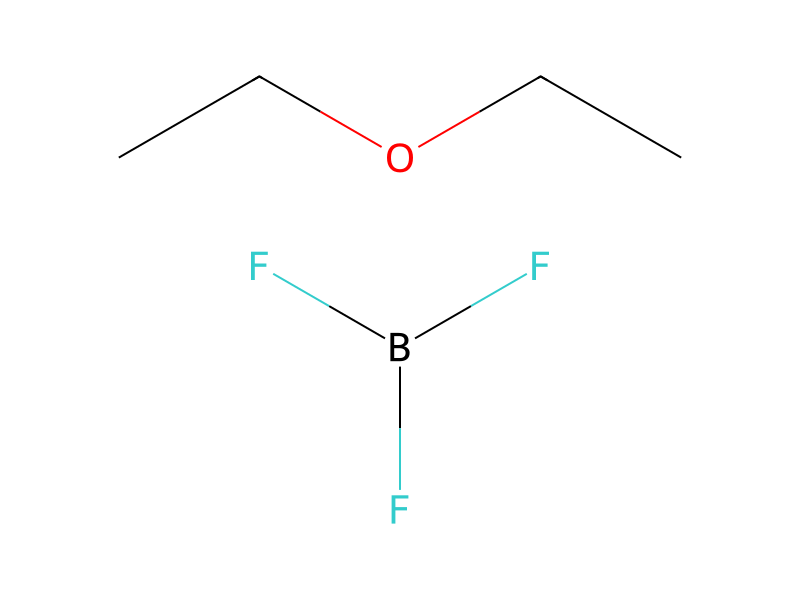

Product 1

Reagents, catalysts & solvents 1

Procedure
A 48.4 g. portion of 3-acetylpyridine was combined with 60 g. of paraformaldehyde and 200 ml. of glacial acetic acid, and to the mixture was added, dropwise with stirring, 86 g. of boron trifluoride etherate. The mixture was then heated, and was stirred under reflux for 4 hours. The reaction was cooled and the volatile materials were evaporated under vacuum to obtain 60 g. of an oily yellow solid, which was crystallized by the addition of water. The solids were separated by filtration, washed with water and dried to obtain 25 g. of the desired product, m.p. 91°-100°.
Workup
- temperatureThe mixture was then heated
- stirringwas stirred
- temperatureunder reflux for 4 hours
- temperatureThe reaction was cooled
- customthe volatile materials were evaporated under vacuum
- customto obtain 60 g
- customof an oily yellow solid, which was crystallized by the addition of water
- customThe solids were separated by filtration
- washwashed with water
- customdried
- customto obtain 25 g
Sources & evidence
- ORD record
- ord-5e17a6783e384cc4bcdd068d1263980e
- Source dataset
- uspto-grants-1983_03
- Patent number
- US04376860
Reaction notes
Loading…