tert-Butyldimethylsilyl chloride → (R)-4-([(tert-butyldimethylsilyl)oxy]methyl)-4-butyrolactone
Reaction equation

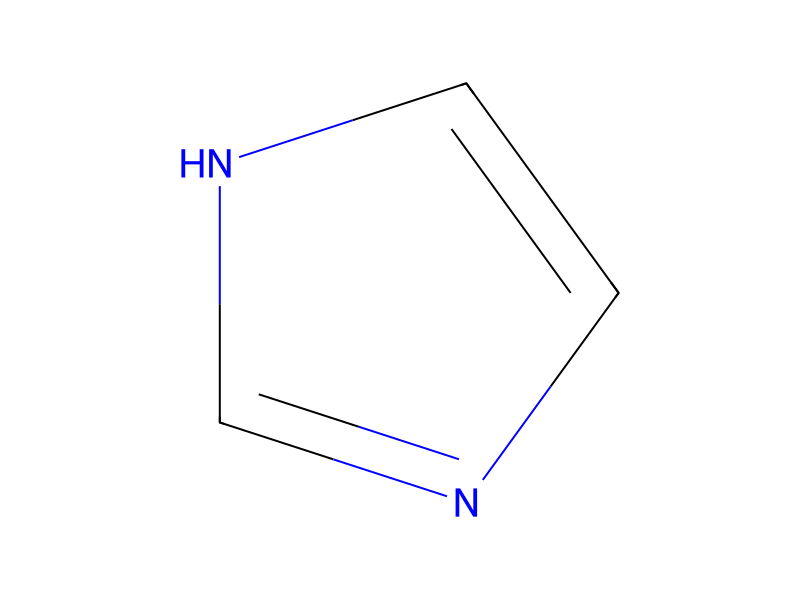
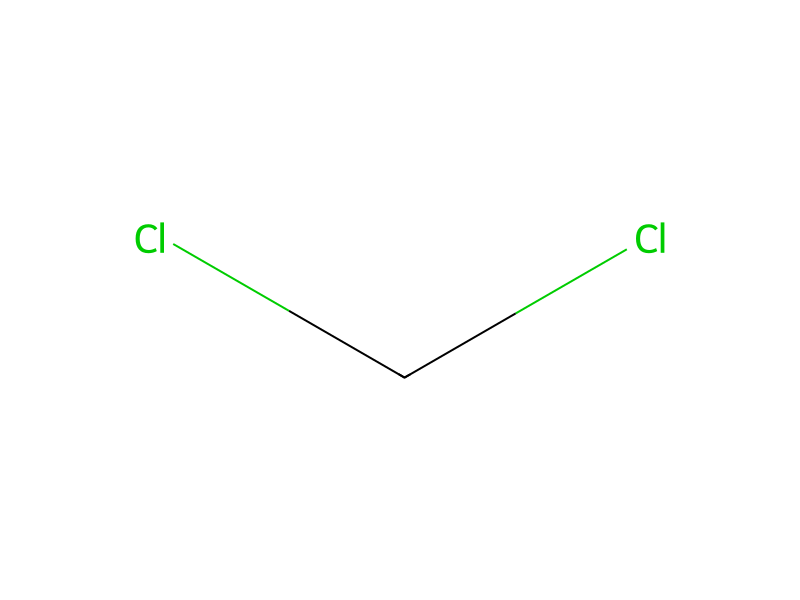
[OH:1][CH2:2][C@@H:3]1[O:8][C:6](=[O:7])[CH2:5][CH2:4]1.[Si:9](Cl)([C:12]([CH3:15])([CH3:14])[CH3:13])([CH3:11])[CH3:10]>C(Cl)Cl.N1C=CN=C1>[Si:9]([O:1][CH2:2][C@@H:3]1[O:8][C:6](=[O:7])[CH2:5][CH2:4]1)([C:12]([CH3:15])([CH3:14])[CH3:13])([CH3:11])[CH3:10]Participants


Procedure
The methodology of Taniguchi et al. (Tetrahedron, 30, 3532, 1974) and Farina et al. (Tetrahedron Lett., 29, 1239, 1988) for the syntheses of D-ribose derivatives provided a model for our synthetic approach to the syntheses of the corresponding L-ribose derivatives. Nitrous acid deamination of D-glutamic acid (1) gave lactone 2, which was then converted to the corresponding ester 3 by treatment of compound 2, with ethanol and catalytic amount of p-toluenesulfonic acid (See Scheme 1). Reduction of compound 3 with NaBH4 in ethanol gave (R)-4-(hydroxymethyl)-4-butyrolactone (4). Protection of the hydroxy group of compound 4 with tert-butyldimethylsilyl chloride in methylene chloride using imidazole as catalyst produced (R)-4-([(tert-butyldimethylsilyl)oxy]methyl)-4-butyrolactone (5), which was then converted to the corresponding lactol 6 by reduction with diisobutyaluminum hydride (DIBAL) in toluene at -78° C. Acetylation of 6 with acetic anhydride and triethylamine afforded the key sugar intermediate, 1-O-acetyl-5-O-(tert-butyldimethylsilyl)-2,3-dideoxy-L-ribofuranose (7) as a mixture of alpha and beta anomers: MS, m/e 231 (M+ --CH3CO), 215 M+ --CH3COO); NMR(CDCl3)) delta 0.10 (s, 6H, SiMe2), 0.95 (s, 9H, tert-butyl), 1.85-2.15 (m, 7H, CH2CH2 and COCH3), 3.50-3.65 (M, 2H, 5-H), 4.10-4.30 (m, 1H, 4-H), 6.20-6.30 (m, 1H, 1-H).
Sources & evidence
- ORD record
- ord-78278913bf304f67b1c1de4ab1495897
- Source dataset
- uspto-grants-1998_11
- Patent number
- US05830881
Reaction notes
Loading…