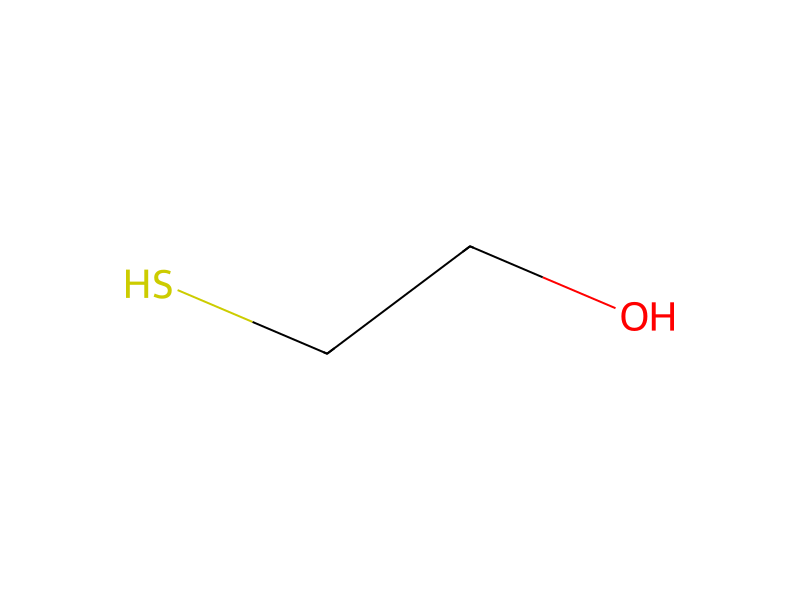
2-Mercaptoethanol → 1,8-Dihydroxy-10-(2-hydroxy-ethylsulfanyl)-10H-anthracen-9-one
Reaction equation

Br[CH:2]1[C:15]2[C:10](=[C:11]([OH:16])[CH:12]=[CH:13][CH:14]=2)[C:9](=[O:17])[C:8]2[C:7]([OH:18])=[CH:6][CH:5]=[CH:4][C:3]1=2.[SH:19][CH2:20][CH2:21][OH:22]>ClCCl>[OH:22][CH2:21][CH2:20][S:19][CH:2]1[C:15]2[C:10](=[C:11]([OH:16])[CH:12]=[CH:13][CH:14]=2)[C:9](=[O:17])[C:8]2[C:7]([OH:18])=[CH:6][CH:5]=[CH:4][C:3]1=2Participants
4
Reactant 2

Product 1

Reagents, catalysts & solvents 1

Procedure
10-Bromo-1,8-dihydroxy-9-anthrone (100 mg) was dissolved in dichloromethane (7 ml) and 2-mercaptoethanol (0.03 ml) was added. The solution was stirred at room temperature for 7 hours, during which time the light brown solution became pale green. Removal of the solvent and recrystallisation of the residue from a hexane/chloroform mixture (5:1) gave 10-(2-hydroxyethylthio)-1,8-dihydroxy-9-anthrone (89 mg, 90%) as pale yellow needles, melting point 146°-147° C.
Workup
- customRemoval of the solvent and recrystallisation of the residue from a hexane/chloroform mixture (5:1)
Sources & evidence
- ORD record
- ord-5ea85ebd568e4a86b1a578bb82a32bf7
- Source dataset
- uspto-grants-1991_03
- Patent number
- US04997961
Reaction notes
Loading…