反应详情
EQUATION
反应方程式

REACTANTS
反应物

PRODUCTS
产物
PROCEDURE
实验过程
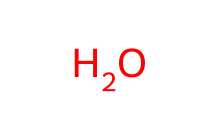
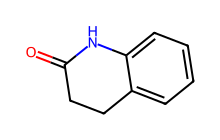
A mixture of 46.8 g (1.2 moles) of sodamide. 400 cc of toluene containing 0.5 cc of oleic acid and 129.2 g (1.0 mole) of quinoline was placed in a liter Magne Drive, equipped as described in Example 15. The autoclave was closed and purged of air with ammonia, pressurized to 30 psig with ammonia and then to 200 psig with nitrogen. The pressure relief valve was set at 350 psig. Cooling water was turned on the reflux condenser. The autoclave was heated with stirring for 2 hours within a range of 138°-148° C. No hydrogen evolution was observed. The autoclave was cooled and vented to atmospheric pressure. The reaction mixture was carefully hydrolyzed (external cooling) with 150 cc of water. The maximum temperature was 30° C. The hydrolyzed mixture contained organic crystalline material. In order to dissolve the crystals, 200 cc of 4-picoline was added and the mixture thoroughly stirred. The aqueous phase was allowed to settle and was removed. The organic phase was placed under vacuum at 40° C. to remove most of the residual ammonia. It was then treated with dry ice and filtered to remove carbonates. The filtrate was topped to a liquid temperature of 110° C. at 50 mm Hg. To the residue was added about 2 parts of toluene and the solution was allowed to crystallize. The mixture was filtered to give 57.4 g of 2-amino-3,4-dihydroquinoline, m.p. of 134.9°-136.3° C. The dihydroquinoline was hydrolyzed in boiling water to give 3,4-dihydrocarbostyril m.p. 165.7°-167.1° C. It is reported in Tetsuji et al., J. Heterocycle Chem., 2, 330 (1965) that the Chichibabin amination of quinoline in toluene at atmospheric pressure gave only 2-aminoquinoline. Derivatives of 3,4-dihydrocarbostryril have anti-inflammatory and blood platelet coagulation activities as claimed by Nakagawa et al., Japan. Kokai 77 73,866.