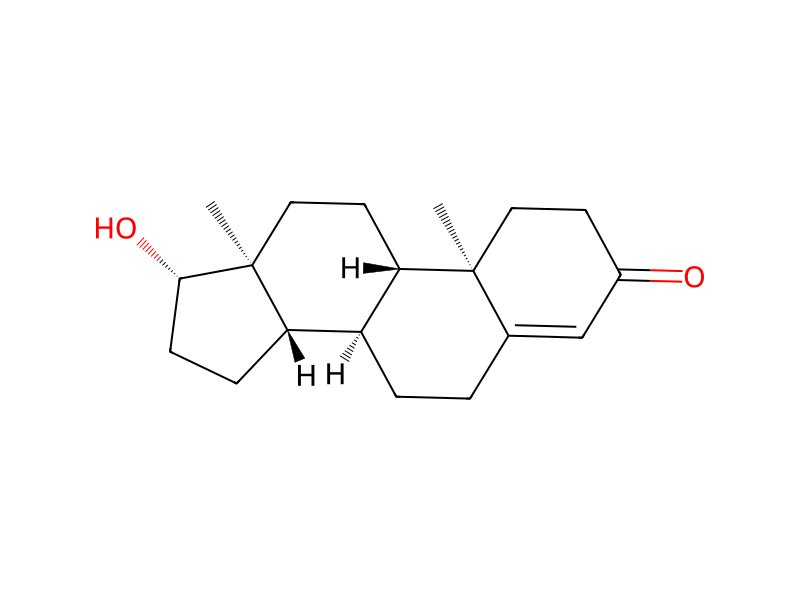
Testosterone → HCID 11121164, compound
Reaction equation

[CH3:1][C@@:2]12[C@@H:10]([OH:11])[CH2:9][CH2:8][C@H:7]1[C@@H:6]1[CH2:12][CH2:13][C:14]3[C@@:20]([CH3:21])([C@H:5]1[CH2:4][CH2:3]2)[CH2:19][CH2:18][C:16](=[O:17])[CH:15]=3.CC(C)([O-])C.[K+].C([O:31][N+:32]([O-])=[O:33])(C)C>CC(C)=O.CCCCCC>[OH:11][C@H:10]1[CH2:9][CH2:8][C@H:7]2[C@H:6]3[C@H:5]([CH2:4][CH2:3][C@:2]12[CH3:1])[C@:20]1([CH3:21])[C:14](=[C:15]([N+:32]([O-:33])=[O:31])[C:16](=[O:17])[CH2:18][CH2:19]1)[CH2:13][CH2:12]3Participants
5
Reactant 3


Product 1

Reagents, catalysts & solvents 1

Procedure
By the method of example 1, testosterone (2.88 g, 10 mM), potassium tert-butoxide (3.40 g, 30 mM) and iso-propylnitrate (1.01 ml) are reacted to yield 17β-hydroxy-4-nitroandrost-4-en-3-one, m.p. 158°-160° C. (acetone-hexane)
Sources & evidence
- ORD record
- ord-900a29b5f10b4497a9378c207e7f397c
- Source dataset
- uspto-grants-1999_02
- Patent number
- US05869475
Reaction notes
Loading…