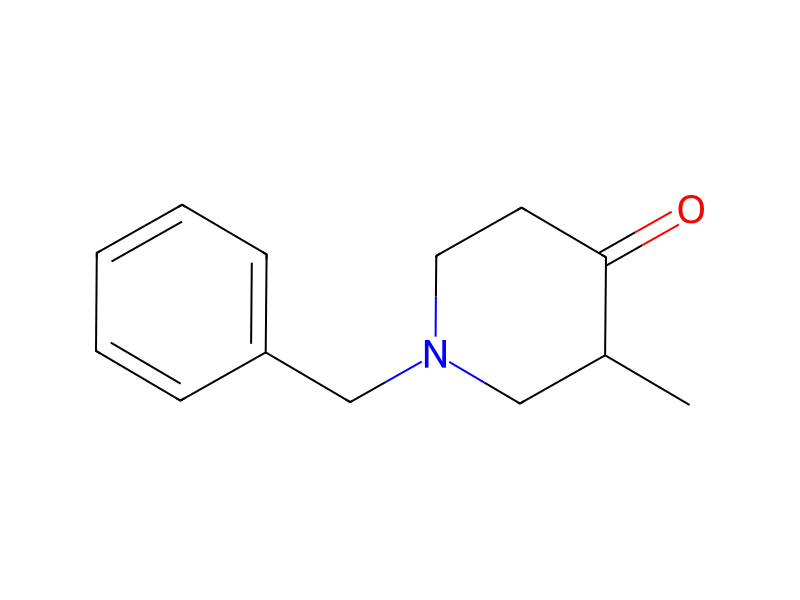
Sodium Hydroxide → 1-Benzyl-3-methyl-4-piperidone
Reaction equation

BrCC(N1C[CH2:9][N:8]([C:11](=O)[C:12]2[CH:17]=[C:16](C)[CH:15]=[C:14](C)[CH:13]=2)[CH2:7][CH:6]1[C:21]1[CH:26]=[CH:25]C(Cl)=C(Cl)C=1)=O.Cl.[O:30]1CCOCC1.[OH-].[Na+]>C(Cl)Cl.O>[CH2:11]([N:8]1[CH2:7][CH2:6][C:21](=[O:30])[CH:26]([CH3:25])[CH2:9]1)[C:12]1[CH:13]=[CH:14][CH:15]=[CH:16][CH:17]=1Participants





Procedure
To a solution of compound 3 (Ar2 =3,4-dichlorophenyl) (16 g, 28.49 mmol) in CH2Cl2 (142.5 mL) at 0° C. was added 4N HCl-dioxane solution (71.24 mL, 284.9 mmol) through a dropping funnel. The reaction was gradually warmed up to RT and stirred for 4 h. After completion the solvents were evaporated to give a light yellow solid which was dissolved in H2O (400 mL) and brought to pH 10 with 1N NaOH. The product was extracted from basic aqueous solution with CH2Cl2 (200 mL, 4×), dried over MgSO4, filtered and concentrated to give compound 4 (Ar2 =3,4-dichlorophenyl) as a light yellow solid (12.5 g, 27.09 mmol, 95%). FAB MS [M+1]+ 35 Cl 461.1 Compound 4 was the key intermediate which was used to couple with various aromatic acid for the synthesis of many compounds.
Workup
- customAfter completion the solvents were evaporated
- customto give a light yellow solid which
- extractionThe product was extracted from basic aqueous solution with CH2Cl2 (200 mL, 4×)
- dry with materialdried over MgSO4
- filtrationfiltered
- concentrationconcentrated
Sources & evidence
- ORD record
- ord-726ed117681d403b90513e13e7bca72a
- Source dataset
- uspto-grants-1999_02
- Patent number
- US05869488
Reaction notes
Loading…