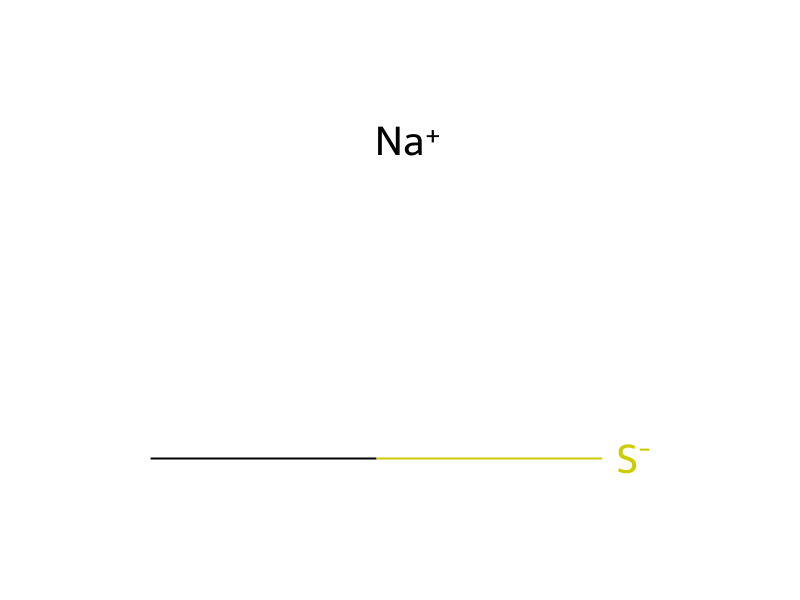
Sodium methanethiolate → HCID 13339912, compound
Reaction equation

ClC1C=C(CN2C(=O)C3=CC=CC=C3C2=O)N=C(OC)N=1.COC1N=C(OC)C=C(CN2C(=O)C3=CC=CC=C3C2=O)N=1.Cl[C:45]1[CH:50]=[C:49]([CH2:51][N:52]2[C:56](=[O:57])[C:55]3=[CH:58][CH:59]=[CH:60][CH:61]=[C:54]3[C:53]2=[O:62])[N:48]=[C:47]([S:63][CH3:64])[N:46]=1.[CH3:65][S-:66].[Na+]>>[CH3:64][S:63][C:47]1[N:46]=[C:45]([S:66][CH3:65])[CH:50]=[C:49]([CH2:51][N:52]2[C:56](=[O:57])[C:55]3=[CH:58][CH:59]=[CH:60][CH:61]=[C:54]3[C:53]2=[O:62])[N:48]=1Participants
5


Procedure
Using the above method, 4-chloro-2-methoxy-6-phthalimidomethylpyrimidine could be converted to 2,4-dimethoxy-6-phthalimidomethylpyrimidine. Similarly, 4-chloro-2-methlythio-6-phthalimidomethylpyrimidine was reacted with sodium methanethiolate to provide 2,4-bis(methylthio)-6-phthalimidomethylpyrimidine, identical in all respects with the compound prepared in Example 1, part D.
Sources & evidence
- ORD record
- ord-9b336f6920674395bafb3eede2de1038
- Source dataset
- uspto-grants-1986_08
- Patent number
- US04604466
Reaction notes
Loading…