Hydrochloric Acid → (R)-1-(benzyloxycarbonyl)-2-azetidinemethanol
Reaction equation

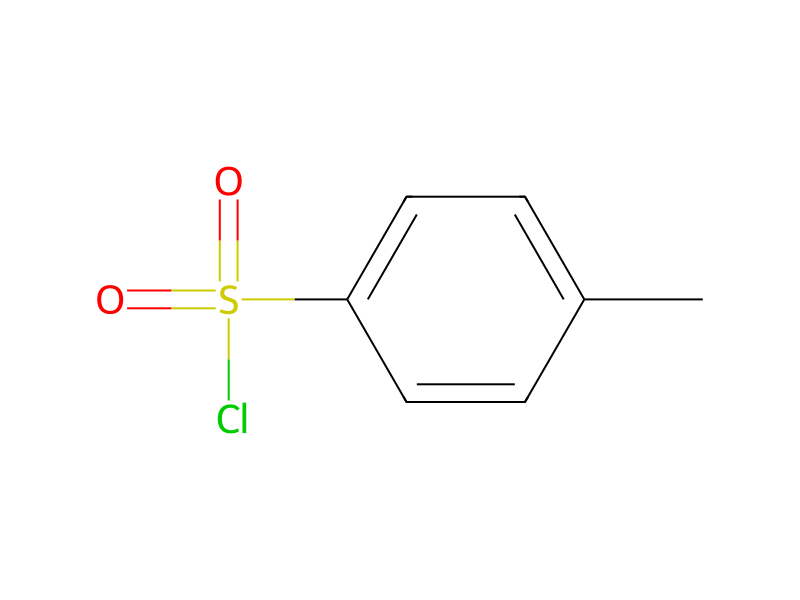
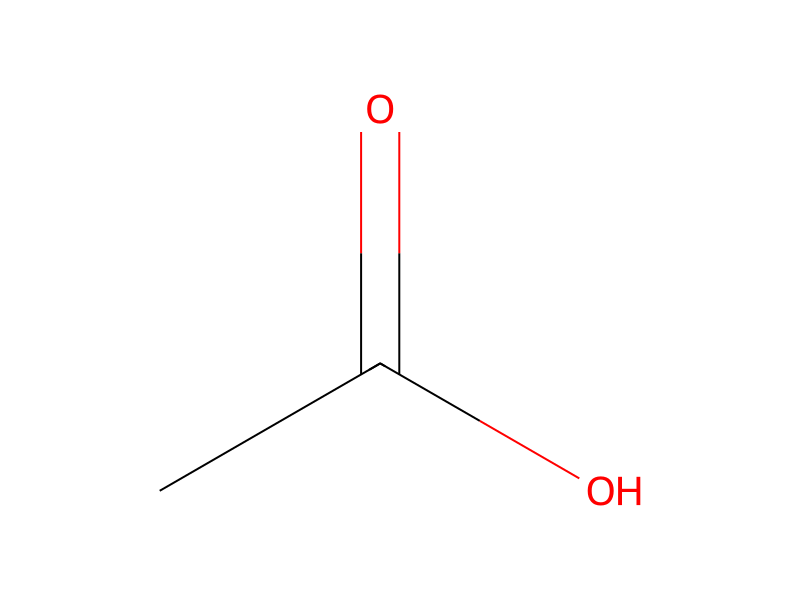
[NH2:1][C@@H:2]([C:7]([OH:9])=O)[CH2:3][CH2:4]SC.[C:10]1([CH3:20])[CH:15]=[CH:14][C:13](S(Cl)(=O)=O)=[CH:12][CH:11]=1.Cl.S(N[C@@H]([C:38]([OH:40])=[O:39])CCSC)(C1C=CC(C)=CC=1)(=O)=O.CI>CC(O)=O.C(O)=O.[OH-].[Na+]>[CH2:20]([O:40][C:38]([N:1]1[CH2:4][CH2:3][C@@H:2]1[CH2:7][OH:9])=[O:39])[C:10]1[CH:15]=[CH:14][CH:13]=[CH:12][CH:11]=1Participants
Reactant 5



Product 1

Reagents, catalysts & solvents 3

Procedure
The title compound was prepared from D-methionine following the procedure of Sugano and Miyoshi, Bull. Chem. Soc. Japan 1973, 46, 669. D-methionine (29.84 g, 200 mmol) was dissolved in H2 0 (100 mL) and 1 N NaOH (200 mL, 200 mmol) was added to give a homogeneous solution. With cooling as necessary to maintain a temperature of ~20° C., p-toluenesulfonyl chloride was added (53.4 g, 280 mmol). Additional 1 N NaOH was added in small portions over 2 hours as needed to maintain the pH ~9 (total ca. 280 mL) and then the mixture was stirred at ambient temperature overnight. The mixture was acidified to pH 3-4 with 4.5 N HCl, then stored at -20° C. A crop of white crystals (26.1 g, 43%) was collected. An additional crop separated as an amber oil, which was collected and dried under vacuum to afford 24.8 g (41%). NMR and MS (m/z 321, (M+NH4)+) of both crops were consistent with pure N-tosyl-D-methionine. The combined crops of N-tosyl-D-methionine (53.5 g, 176 mmol) were dissolved in HOAc (53 mL) and 88% HCO2H (106 mL), then methyl iodide (20 mL) was added and the mixture was allowed to stand in the dark overnight. The volatile components were evaporated under reduced pressure, and the residue was triturated repeatedly with ethyl ether to afford a semi-solid residue, which was dissolved in 1 N NaOH (180 mL). The solution was kept at 90° C. for 3 hours while maintaining pH 6-7 by addition of 3 N NaOH. The solution was acidified to pH 2-3 with 3 N HCl and a white precipitate was collected by filtration and dried to afford 28 g of α-(N-p-tosylamino)-γ-butyrolactone. Additional crops were obtained following storage of the mother liquors at -20° C. to afford an additional 8.3 g of product (combined yield 81%), mp 132-134° C. MS: m/z 273 (M+NH4+), 291 M+(NH4)2)+. Following the procedure of Miyoshi, et al., (Chem. Lett., 1973, 5-6), a suspension of (R)-α-(N-p-tosylamino)-γ-butyrolactone (20 g) in EtOH (150 mL) was held at 65° C. while HBr(g) was bubbled into the the mixure. After the mixture became homogeneous, slow bubbling of HBr was continued at 65° C. to maintain maximal saturation throughout the reaction. The volatile components were evaporated, then the residue was chromatographed (silica gel; 30% EtOAc/hexane) to afford 17.8 g (ca. 65%) of (R)-N-tosyl-γ-bromonorvaline ethyl ester as a slightly yellow oil. MS: (CI/NH3) m/z 301 (M-HBr+NH4)+ ; 381 (M+NH4)+ ; M+(NH4)2)+. To N-tosyl-γ-bromonorvaline ethyl ester (24.24 g, 66.5 mmol) in DMF (725 mL) was added H2O (3.64 mL) followed by 60% NaH (8 g). The mixture was stirred at 10-20° C. for 20 min, after which the mixture was acidified with 1 N HCl, the solvents were evaporated, and CH2Cl2 was subsequently added and evaporated twice. Addition of 10% HCl precipitated the product, which was collected and recrystallized from EtOAc/petroleum ether to afford 12.3 g (72%) of (R)-N-tosylazetidine-2-carboxylic acid as white floculent crystals: mp 144-145° C.; [α]D +146 (c 0.61, CHCl3); MS (CI/NH3) m/z 273 (M+NH4)+. Further manipulations were carried out as described in Abreo, et al., J. Med. Chem. 1996, 39, 817-825. Analysis of enantiomeric purity was carried out by conversion to the α-methylbenzylamide, and evaluation by 1H-NMR, which indicated a ca. 4:1 mixture of enantiomers. This mixture (1.48 g, 5.8 mmol) was slurried in liquid NH3 (25 mL) at -78° C. Sodium metal was added until a dark blue color persisted for 30 minutes and then solid ammonium chloride was added until the blue color disappeared. The cold bath was replaced with a water bath as the ammonia was allowed to evaporate. The remaining white solid was carefully dissolved in H2O (30 mL) and HOAc to adjust the mixture to pH 7.0. Then 1,4-dioxane (30 mL) and N-(benzyloxycarbonyloxy)succinimide (2.1 g, 8.7 mmol) were added and the mixture was stirred for 2 h. The biphasic mixture was partitioned between saturated K2CO3 and Et2O and the phases were separated. The aqueous phase was acidified with 12 N HCl and then extracted with CH2Cl2. The organic phase was dried (MgSO4), concentrated, and chromatographed (silica gel; CHCl3 /MeOH/HOAc, 95:5:0.5) to afford a colorless oil (955 mg, 70%): MS (CI/NH3) m/z: 236 (M+H)+ ; 1H NMR (CDCl3, 300 MHz) δ 2.47-2.60 (m, 2H) 3.98-4.07 (m, 2H), 4.78-4.87 (m, 1H), 5.65 (s, 2H), 7.28-7.40 (m, 5H). The resultant 1-benzyloxycarbonyl azetidine-2-carboxylic acid (932 mg, 3.96 mmol) was dissolved in MeOH (20 mL) and L-tyrosine hydrazide (773 mg, 3.96 mmol) was added. The slurry was heated at reflux for 10 minutes, allowed to cool to ambient temperature and then filtered. The filter cake was dissolved in 6 M HCl and extracted with EtOAc (2×). The organic fractions were combined, dried (MgSO4) and concentrated to give (R)-1-benzyloxycarbonyl azetidine-2-carboxylic acid as a colorless oil (403 mg, 55%): [α]D20 +104.7 (c 4.0, CHCl3). The (R)-1-benzyloxycarbonyl azetidine-2-carboxylic acid (2.0 g, 8.6 mmol) in THF (35 mL) was cooled to 0° and 1.0 M BH3.THF (12.9 mL, 12.9 mmol) was added dropwise. The mixture was allowed to warm to ambient temperature and stirred for 2.5 hours. A solution of 2 N HCl was carefully added and the heterogenous mixture was allowed to stir for 1 hour. The slurry was extracted with CH2Cl2 and the organic phase was dried (MgSO4), concentrated, and chromatographed (silica gel; EtOAc/hexane, 1:1) to afford the title compound as a colorless oil (1.46 g, 77%): [α]D20 15.5 (c 1.2, CHCl3). MS (CI/NH3) m/z: 222 (M+H)+ ; 1H NMR (CDCl3, 300 MHz) δ 1.93-2.08 (m, 1H) 2.18-2.29 (m, 1H), 3.72-4.01 (m, 4H), 4.47-4.58 (m, 1H), 5.12 (s, 2H), 7.30-7.41 (m, 5H).
Workup
- customto give a homogeneous solution
- temperatureWith cooling as necessary
- additionwas added (53.4 g, 280 mmol)
- temperatureto maintain the pH ~9 (total ca. 280 mL)
- customstored at -20° C
- customA crop of white crystals (26.1 g, 43%) was collected
- customAn additional crop separated as an amber oil, which
- customwas collected
- customdried under vacuum
- customto afford 24.8 g (41%)
- customto stand in the dark overnight
- customThe volatile components were evaporated under reduced pressure
- customthe residue was triturated repeatedly with ethyl ether
- customto afford a semi-solid residue, which
- waitThe solution was kept at 90° C. for 3 hours
- temperaturewhile maintaining pH 6-7
- filtrationa white precipitate was collected by filtration
- customdried
Sources & evidence
- ORD record
- ord-2d2a63ec31104494bc5736370460de30
- Source dataset
- uspto-grants-2000_10
- Patent number
- US06133253
Reaction notes
Loading…