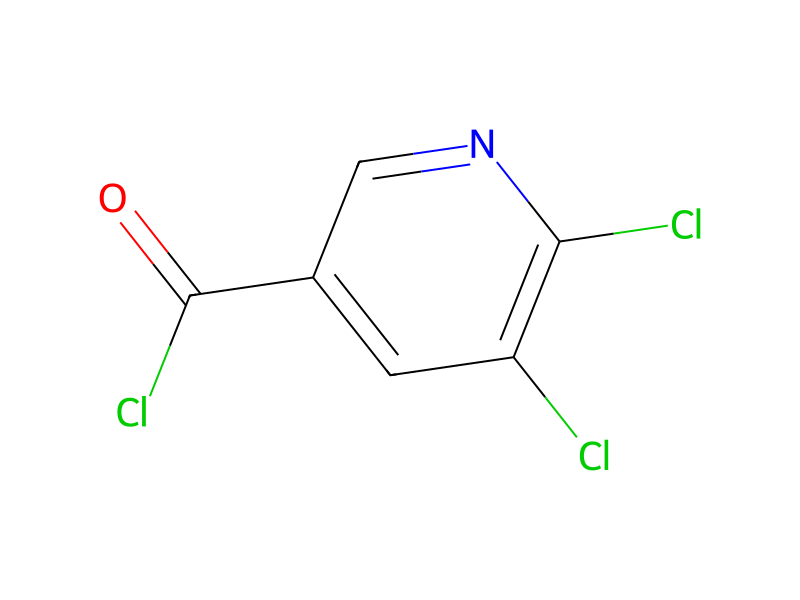
5,6-dichloropyridine-3-carbonyl Chloride → 3-t-Butyl-5-(5,6-dichloro-3-pyridyl)-1,2,4-oxadiazole
Reaction equation

[Cl:1][C:2]1[CH:3]=[C:4]([C:9](Cl)=[O:10])[CH:5]=[N:6][C:7]=1[Cl:8].O[NH:13][C:14](=[NH:19])[C:15]([CH3:18])([CH3:17])[CH3:16]>C1(C)C=CC=CC=1>[C:15]([C:14]1[N:19]=[C:9]([C:4]2[CH:5]=[N:6][C:7]([Cl:8])=[C:2]([Cl:1])[CH:3]=2)[O:10][N:13]=1)([CH3:18])([CH3:17])[CH3:16]Participants
4
Reactant 2

Product 1

Reagents, catalysts & solvents 1

Procedure
A mixture of 5,6-dichloro-pyridine-3-carbonyl chloride (1.8 g, 8.6 mmol) and N-hydroxy-2,2-dimethylpropanimidamide (1.0 g, 8.6 mmol) in toluene (40 mL) was stirred at room temperature for two hours and then heated under reflux for four hours. The mixture was cooled to room temperature and filtered through celite, the solids being washed with toluene (20 mL). Evaporation of the combined filtrates under reduced pressure gave the desired product (1.3 g, 56%) as a clear oil which crystallised on standing to a white solid, MP 98-101° C.
Workup
- temperatureheated
- temperatureunder reflux for four hours
- temperatureThe mixture was cooled to room temperature
- filtrationfiltered through celite
- washthe solids being washed with toluene (20 mL)
- customEvaporation of the combined filtrates under reduced pressure
Sources & evidence
- ORD record
- ord-a91589b60f7c45e6ae0ca46b4c1d3979
- Source dataset
- uspto-grants-2000_10
- Patent number
- US06133294
Reaction notes
Loading…